
Imagine you’re cruising down I-40 near downtown Oklahoma City in the middle of a blazing July day. The asphalt is radiating a heat so intense you could probably cook an egg on it. Then, out of nowhere, a sound like a shotgun blast rips through your car. The steering wheel jerks from your hands, and your vehicle lurches violently toward the median.
This isn’t just a scene from a movie, it’s a terrifying reality for thousands of drivers every single year. A tire blowout happens in a split second, but the causes have usually been building up over months of neglect. While you can’t control every piece of debris on the road, you absolutely can control the condition of the rubber that keeps you on it.
Key Takeaways
- Every year in the U.S., tire blowouts are responsible for 11,000 crashes and tragically, hundreds of deaths.
- The main culprit is underinflation, having your tires just 25% low on air triples your risk of a catastrophic failure.
- Heat is your tire’s worst enemy. Underinflated tires flex too much, which builds up intense heat and causes them to disintegrate from the inside out.
- Teen drivers, and any vehicle traveling at highway speeds, face the highest risks of a blowout.
- Your car’s Tire Pressure Monitoring System (TPMS) is a lifesaver that also saves you money on fuel, but it only works if you pay attention to its warnings.
- How you react in the first second matters most. Do not slam on the brakes. Steer straight and let the car coast to a safe stop.
The Alarming Reality of Tire Blowouts on US Roads
A tire failure is a sudden, violent event that plays a significant role in accident statistics all across the nation. The National Highway Traffic Safety Administration (NHTSA) reports that problems with tires lead to approximately 11,000 crashes in the United States annually. And these aren’t just minor fender benders. In 2022 alone, 563 people lost their lives because of a tire blowout or a related failure. While this number is a small improvement from the 622 fatalities recorded in 2021, it remains a tragically high figure for a problem that is largely preventable.
The mechanics of why these crashes happen often boil down to something as simple as air pressure. A major factor in these accidents is underinflation. Tires that are underinflated by more than 25% are a staggering three times more likely to suffer a blowout compared to those filled to the proper pressure. This is a critical piece of information for parents of young drivers to grasp. In fact, teen drivers are involved in nearly 300,000 of the 2.2 million annual U.S. accidents that are linked back to tire issues like worn-out treads or improper inflation.
The National Motor Vehicle Crash Causation Survey, which sampled over 5,470 crashes, found that 9% of them involved a pre-crash tire problem. These dangerous incidents happen most frequently on highways and interstates, where higher speeds generate more heat and stress, turning what might be a minor defect into a catastrophic, life-altering failure. Tire trouble is only one of the roadside problems drivers can face, and knowing some common roadside quick fixes can be useful when you’re caught off guard.
The Causes of Blowouts
A catastrophic tire failure rarely just happens out of the blue. There are usually specific factors conspiring to destroy the structural integrity of your tire. Understanding what these elements are is the very first step you can take to protect yourself and your vehicle.
Underinflation and Overinflation
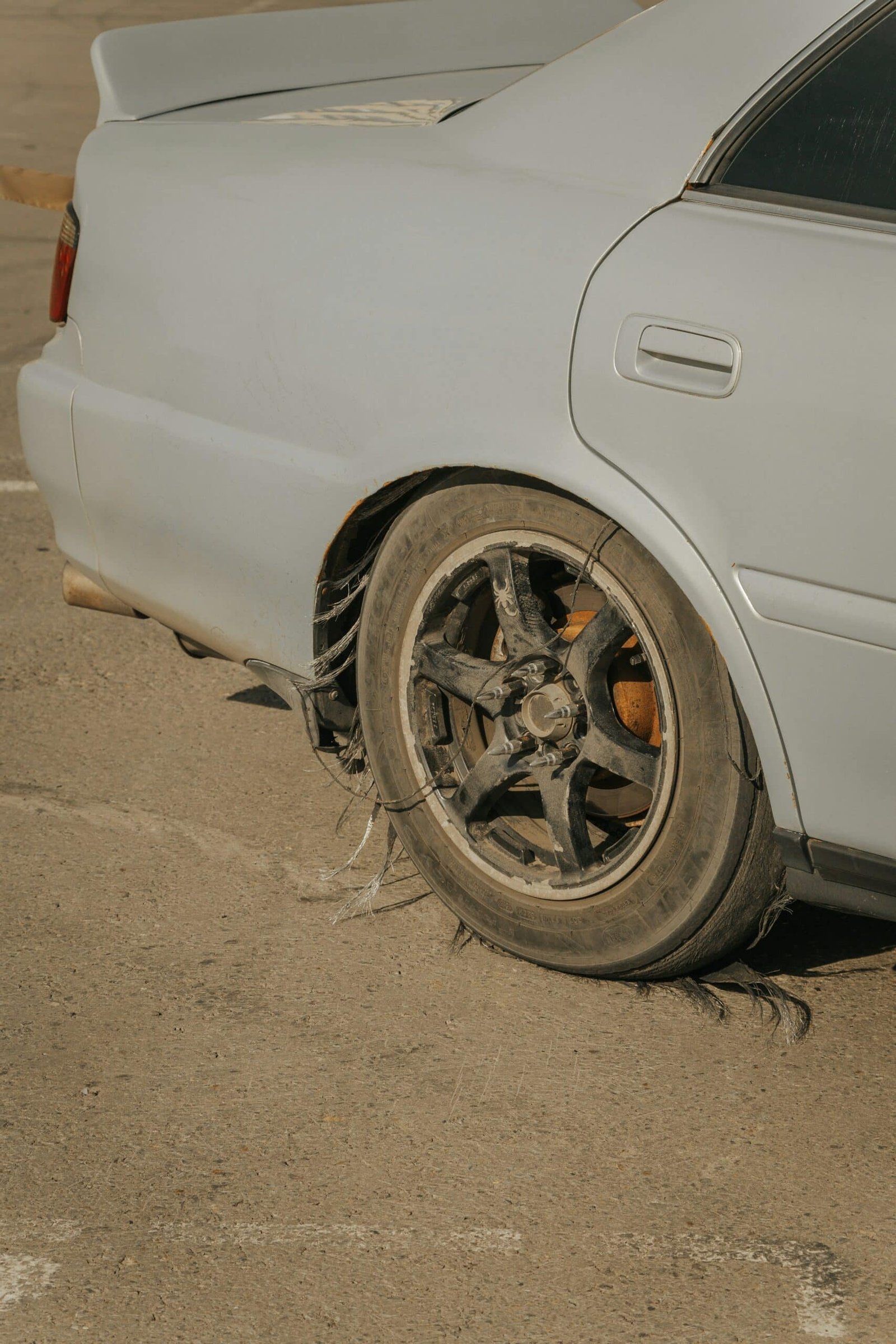
By far, the leading cause of tire failure is improper air pressure. An underinflated tire isn’t just soft, it’s a disaster waiting to happen. When a tire doesn’t have enough air, its sidewalls are forced to flex excessively with every single rotation. This constant flexing generates an intense amount of internal heat. If that heat builds up beyond what the tire’s materials can handle, the tire begins to disintegrate from the inside out, which often results in a dramatic sidewall blowout.
Tires operating at more than 25% below the recommended pressure which is typically between 30-40 psi for most passenger cars are squarely in the danger zone. Even a small deviation of 20-25% can create significant, damaging heat. Despite this clear risk, awareness among drivers is alarmingly low. Studies have shown that 34% of men and 50% of women rarely, if ever, check their tire pressure. On the flip side, overinflation makes the tire too rigid and hard. A rock-hard tire can’t properly absorb impacts from potholes or road debris, making it much more likely to pop when it hits something.
Worn Treads and Hidden Damage
Over time, the rubber on your tires simply wears down, losing its crucial ability to grip the road and resist punctures. Tires with worn-out treads are far more susceptible to failure. To keep up with safety standards, you need to measure your tread depth to the nearest 1/32 of an inch. Once that tread is gone, the tire is not only unsafe, it’s illegal. What’s more, damage from past incidents can often lurk unseen. Things like tread separation or internal tears from hitting a curb months ago can create weak points inside the tire. These hidden defects are just waiting for a high-stress moment, like a long highway drive, to completely fail.
Road Hazards, Overloading, and High Speeds
Oklahoma roads can be unforgiving. Potholes, jagged curbs, and scattered construction debris can inflict immediate trauma on a tire’s structure. Hitting a deep pothole at highway speeds magnifies that damage exponentially. Additionally, every vehicle has a specific load limit set by the manufacturer. Pushing past this limit puts an immense strain on your tires, forcing them to carry a weight they were never designed to support. It’s important to remember that blowouts are much more likely to happen at sustained highway speeds than in stop-and-go city traffic, especially for heavy-duty vehicles or any vehicle driven long distances under a heavy load. These are just some of the frequent minor breakdown causes that can leave drivers stranded.
Your Complete Checklist for Preventing a Tire Blowout
The good news is that proactive maintenance can prevent the vast majority of tire failures. You don’t need to be a professional mechanic to keep your family safe, you just need to build a simple routine.
The Monthly Tire Health Checkup
Set a recurring reminder on your phone to perform these simple checks at least once a month, and always before you head out on a long road trip.
Check Tire Pressure
You should always maintain the pressure recommended by your vehicle’s manufacturer. You can find this information on a sticker inside the driver’s door jamb, and it’s usually between 30-40 psi. It’s crucial to check your tires when they are “cold”, meaning the car has been parked for at least three hours. Driving heats up the air inside your tires, which can give you a falsely high reading. Keeping your tires properly inflated is the number one thing you can do to stop the lethal heat buildup that causes blowouts.
Inspect Tread Depth
Your tire’s grip is what keeps you safely on the road. You can use a simple tread depth gauge or the classic “penny test.” To do the test, just insert a penny into one of the tread grooves with Lincoln’s head facing down. If you can see all of Honest Abe’s head, it means your tires have less than 2/32 of an inch of tread left and need to be replaced immediately. Inadequate tread depth drastically reduces your traction and can turn wet roads into dangerous skating rinks.
Perform a Visual Inspection
Get down on your hands and knees and take a close look at your tires. Scan the entire surface for any cracks, cuts, bulges, or tears in the sidewalls. A bulge looks like a bubble forming on the rubber surface, and it’s a clear sign that the internal frame of the tire has collapsed. A tire with a bulge is a ticking time bomb and should be replaced without delay.
Smart Habits for Tire Longevity
How you drive and how well you stick to a maintenance schedule directly impacts how long your tires will last.
Rotate Your Tires Regularly
Your front and rear tires wear down at different rates because of things like steering and weight distribution. By rotating your tires every 5,000 to 8,000 miles, you help them wear down more evenly. This simple service not only extends the life of your entire set of tires but also ensures your car handles in a balanced, predictable way.
Avoid Overloading and High Speeds
Always respect your vehicle’s limits. You can find the load rating on the same sticker on the driver’s side door jamb, never exceed it. When you are loading up your car, try to distribute the cargo weight evenly to avoid putting too much stress on one side of the suspension. And just as importantly, drive the speed limit. Excessive speed generates excessive heat, which can push aging or damaged tires past their breaking point.
Use Quality Tires
Don’t try to cut corners on the only parts of your car that actually touch the ground. Make sure the tires you buy are the correct type and size for your vehicle, the payload you typically carry, and the environment you drive in.
Your Tire Pressure Monitoring System (TPMS)
Chances are, your car already has a built-in safety net. The Tire Pressure Monitoring System (TPMS) is a critical feature that acts as your first line of defense against underinflation, the condition that precedes about 75% of all roadside flats.
How TPMS Saves Lives and Money
Studies from the NHTSA have proven just how effective this technology is. Before TPMS was mandated, vehicles without it had a 23.1% rate of severely underinflated tires. For vehicles equipped with TPMS (from model years ’04-’07), that rate dropped to 11.8%. In newer models (’08-’11), it fell even further to just 5.7%.
Beyond the obvious safety benefits, this system also protects your wallet. The NHTSA estimated that keeping tires properly inflated, thanks to TPMS, saved drivers a collective $511 million in fuel in 2011 alone. Despite these amazing benefits, a concerning 58% of drivers still don’t recognize the yellow, horseshoe-shaped warning symbol when it lights up on their dashboard.
What is the Difference between Direct and Indirect TPMS?
There are two types of systems out there. Direct TPMS uses small, battery-powered sensors inside each tire to send precise pressure and temperature data directly to your dashboard. Indirect TPMS is a software-based system, it cleverly uses your vehicle’s anti-lock brake system (ABS) sensors to measure how fast each wheel is rotating. A soft, underinflated tire has a slightly smaller radius, so it has to spin faster than a fully inflated one. While a 2018 EU study of 1,470 vehicles found that both systems are effective at preventing severe underinflation, direct systems generally provide more precise, real-time data.
How to Safely Handle a Tire Blowout While Driving
If one of your tires blows, your first gut instinct will be to slam on the brakes. You must fight this instinct with everything you have. Hitting the brakes hard shifts your vehicle’s weight forward, which can easily cause you to spin out or even flip over if a tire has been destroyed.
- Grip the Wheel. Grab the steering wheel firmly with both hands, ideally at the 10 and 2 positions. The car is going to pull hard to the side of the blowout, your job is to wrestle it and keep it pointed straight.
- Gently and smoothly ease your foot off the accelerator. Do not brake.
- Concentrate on steering straight ahead. Allow the drag created by the flat tire to gradually slow the vehicle down for you.
- Once you feel you have full control and your speed has dropped significantly (below 30 mph), turn on your signal and pull off the road as far to the side as you possibly can. Once you’re safely off the road, follow these roadside tire change safety tips before attempting to change the tire.
The Lasting Benefits of Proactive Tire Care
Being consistent with your tire maintenance delivers value that goes far beyond just avoiding a scary roadside incident. It boosts your car’s overall safety by sharpening its handling and shortening braking distances. It keeps more money in your pocket through better fuel efficiency and by extending the life of your tires, delaying the need for an expensive new set. What’s more, properly inflated tires have lower rolling resistance, which reduces fuel consumption and lowers your vehicle’s emissions, helping our local Oklahoma environment. Combining regular visual checks with a functional TPMS is the most effective way to reduce your risk of becoming one of the 11,000 annual tire-related crash statistics.
If you ever do find yourself stranded on the side of the road in Oklahoma City, whether it’s from a blowout or engine trouble, Five Star Towing is ready and waiting to help. We provide fast, professional towing and roadside assistance to get you and your vehicle to safety. Don’t risk staying on the shoulder of a busy highway for a minute longer than necessary. Get flat tire assistance from local experts who are ready to help.
Frequently Asked Questions
Without a doubt, the primary cause of tire blowouts is driving on underinflated tires.
When a tire doesn't have enough air pressure, its internal parts (like the steel belts and fabric cords) are forced to flex way too much. This excessive movement generates intense friction and heat inside the tire.
According to the NHTSA, tires that are underinflated by 25% or more are three times as likely to be involved in a crash related to tire problems. This heat breaks down the bonds holding the tire's components together, leading to separation and an eventual, sudden rupture.
Make it a habit to check your tire pressure every month and before any long trip to make sure they match the manufacturer's recommended PSI.
Often, your tires will give you physical warnings before they fail completely.
You might start to feel unusual vibrations through the steering wheel or your seat, which often get worse as you speed up. If you look at the tire, you might see noticeable bulges, blisters, or deep cracks in the sidewall.
These signs point to serious structural damage inside the tire. A bulge, for example, means air has broken through the inner lining and is trapped between the layers of the tire, signaling that a burst is imminent.
If you feel a new, strange vibration or see any kind of deformity on your tire, you should stop driving immediately and get the tire replaced. Ignoring these sensory cues can lead to a very dangerous blowout at highway speeds.
The warning signs of a failing tire generally fall into three categories, things you hear, things you feel, and things you see.
Listen for any thumping or rhythmic clicking sounds as you drive. Feel for any new vibrations in the steering wheel or if the vehicle seems to be "pulling" to one side. Look for obviously uneven tread wear or foreign objects like nails stuck in the rubber.
Uneven wear often points to an alignment or suspension problem, which puts uneven stress on the tire. A thumping sound usually means a tread is separating or the tire has developed a flat spot.
Try to incorporate a quick "look and listen" approach into your daily commute. If your car just feels different than it did yesterday, take a moment to inspect your tires right away.
As a rule of thumb, you should check your tire pressure at least once a month.
Tires naturally lose about 1 psi of pressure per month just through normal permeation. Big temperature swings also affect pressure for every 10-degree Fahrenheit drop in temperature, your tire pressure will drop by about 1 psi.
NHTSA data clearly shows that keeping tires properly inflated can save drivers a significant amount of money in fuel costs and, more importantly, prevent accidents. Yet, a large percentage of drivers rarely check.
A great way to remember is to tie this task to another monthly routine, like the first time you fill up your gas tank each month. And always remember to check the pressure when the tires are cold for the most accurate reading.
A blowout is a very distinct and loud noise, often compared to a gunshot or a small sonic boom.
That loud "bang" is the sound of all the air inside the tire escaping so rapidly that it actually breaks the sound barrier as the tire casing ruptures under pressure.
Immediately after that initial "bang," you will hear a loud, rhythmic flapping or flopping noise. This is the sound of the deflated rubber slapping against the road and the inside of your wheel well as the wheel continues to spin.
This sound is your immediate cue to grip the wheel firmly and NOT slam on the brakes. The noise itself is frightening, but giving in to panic is the real danger.
No, you should never, ever slam on the brakes during a blowout.
Braking hard shifts your vehicle’s weight onto the front wheels. If a front tire has just blown, this added weight will make the pull to that side much worse, potentially causing your vehicle to spin out of control or even roll over.
The safest thing you can do is to maintain pressure on the gas pedal for a brief moment to help stabilize the car, then slowly and smoothly lift your foot off the accelerator.
Let the natural drag from the flat tire slow your vehicle down. You should only apply the brakes gently once you have regained full steering control and have slowed to below 30 mph.
Blowouts are most common at highway speeds, which is typically anything above 55 mph.
High speeds generate much higher temperatures within the tire. If a tire is already compromised by low air pressure or hidden damage, this extra heat is often the final straw that pushes it past its failure point.
Statistics from numerous tire safety studies show that most tire-related accidents happen on highways, where the sustained speed prevents the tire from having any chance to cool down.
Be extra vigilant about your tire's condition before you get on an interstate or highway, especially during our hot Oklahoma summers.
Absolutely. A hard impact with a pothole can cause either an immediate or a delayed blowout.
When you hit a pothole, the tire gets compressed against the wheel rim with tremendous force, which can be enough to slice the internal liner or the sidewall.
This can cause an immediate, explosive rupture (sometimes called a "pinch shock") or it can create a bubble in the sidewall that holds for now but could fail days or even weeks later.
If you hit a deep pothole, pull over when it's safe and inspect the tire immediately for any visible bulges or cuts. Even if it's still holding air, the internal structure may have been ruined.
Heat is one of the biggest enemies of your tire's integrity.
Heat causes the air inside your tire to expand, which increases the pressure. Even more importantly, hot pavement and high ambient temperatures make the rubber itself softer and the internal bonds that hold it together weaker.
Here in places like OKC, road surface temperatures can easily exceed 140°F in the summer. If you have an underinflated tire that is already generating its own friction heat, and you combine that with extreme road heat, the tire can start to come apart at the seams.
During the summer months, check your tire pressure more frequently, preferably in the cool morning air, to make sure your tires aren't running low and getting dangerously hot.
The penny test is a wonderfully simple and quick way to check if your tires are still legal and safe to drive on.
Take a penny and place it into one of your tire's main tread grooves with Abraham Lincoln's head facing down, toward the tire.
If you can see the top of Lincoln's head, your tread depth has worn down to less than 2/32 of an inch.
At this depth, the tire has lost most of its ability to channel water away, which drastically increases your risk of hydroplaning on wet roads and makes it more susceptible to blowouts. The tire must be replaced right away.
Yes, absolutely. Tires degrade and become unsafe with age, regardless of how much tread they have left.
The rubber compounds in tires oxidize over time, causing them to become dry and brittle. This aging process happens from the inside out and is sped up by exposure to heat and sunlight.
Most tire manufacturers recommend replacing your tires after 6 to 10 years, even if they look brand new. You can find the date of manufacture in the DOT code stamped on the sidewall; the last four digits represent the week and year.
An old tire might look perfectly fine, but its internal structure can be weak and prone to tread separation, especially at highway speeds. If your tires are more than six years old, you should have them inspected by a professional at least once a year.
Your TPMS is designed to alert you to low tire pressure long before it becomes a critical, blowout-level situation.
It uses sensors to continuously monitor the air pressure inside your tires and will illuminate a warning light on your dashboard if the pressure in any tire drops by 25% or more below the recommended level.
NHTSA studies have shown that vehicles equipped with TPMS have significantly fewer incidents of severely underinflated tires when compared to those without the system.
It's important to remember that TPMS is a warning system, not a replacement for good maintenance habits. The light usually triggers when the tire is already significantly low. You should still manually check your tire pressure every month to catch slow leaks early.