
Gravity doesn’t play favorites, especially when an 80,000-pound semi-truck finds itself in a ditch along I-35. In moments like these, standard roadside assistance is simply out of its league. You need machinery that was engineered to go head-to-head with physics and win. Heavy-duty towing is about more than just brute force; it’s about applying immense power with the precision of a surgeon.
It requires equipment that can stabilize, lift, and recover massive loads without causing more damage or endangering the people on site. For fleet managers and owner-operators in Oklahoma City, understanding the tools of the trade can mean the difference between a successful recovery and a logistical nightmare.
Key Takeaways
- The big rigs of the towing world, heavy-duty trucks are built on Class 7 or 8 chassis to tackle loads from 26,000 to over 80,000 pounds.
- Think of it like this, the chassis is the sturdy backbone, and the wrecker body is the powerful muscle doing all the heavy lifting.
- For tricky situations like rollovers, rotators are the heroes, offering a full 360-degree range of motion to get the job done.
- Don’t count out heavy-duty pickups; a properly equipped Ford F-450 can pull its weight, managing up to 40,000 pounds with the right hitch.
- It all comes down to safety staying within GVWR limits and using the right equipment, like gooseneck hitches, is non-negotiable.
What Defines a Heavy-Duty Tow Truck?
In the world of towing, size really does matter. A heavy-duty tow truck is officially defined by its gross vehicle weight rating (GVWR), which has to exceed 26,000 pounds. Many of these units operate well above that baseline, sometimes reaching 80,000 pounds or more just to have enough mass to counteract the weight of the vehicles they rescue. These powerful machines are built on rugged Class 7 or Class 8 chassis. To handle the incredible forces involved, manufacturers reinforce the frames and install specialized suspension systems to maintain stability under immense strain.
This isn’t a job for your standard tow truck. A typical light-duty truck can handle about 3 to 5 tons. Heavy-duty units, on the other hand, need a lifting and pulling capacity that ranges from an impressive 25 to 100 tons. This incredible power is what allows operators to effectively recover semi-trucks, buses, and RVs. According to industry data, this massive gap in capability is the very reason why specific, powerful equipment is legally required for any commercial recovery operation.
Heavy-Duty Chassis and Wrecker Bodies
Peak performance really comes down to two main things, the truck that powers the whole system and the specialized equipment that actually lifts the load. Pairing the right chassis with a capable wrecker body is the key to ensuring every operation is safe. Think about it if the chassis doesn’t have enough torque, the truck simply can’t move the load. And if the frame is too weak, the wrecker body could literally twist it during a lift.
A Breakdown of Top Heavy-Duty Chassis
A quick comparison of the leading chassis models really shines a light on the incredible engineering that goes into these jobs.
- Ford F-550 Super Duty is a versatile and popular choice for those getting into heavy towing. It boasts a GVWR of up to 19,500 lbs. Operators can choose between a 6.7L Power Stroke V8 Diesel that churns out 330 hp and 825 lb-ft of torque, or a 7.3L V8 Gas engine with 350 hp and 468 lb-ft. Both engines are paired with a smooth TorqShift 10-speed transmission. You can expect base prices to generally range from $40,000 to over $80,000.
- Peterbilt 389 is a true staple on Oklahoma highways, this truck brings some serious power to the table. It runs on a PACCAR MX-13 engine delivering 510 hp and 1,850 lb-ft of torque, or a Cummins X15 that hits 565 hp. Pricing for these powerhouses starts around $150,000.
- Kenworth T880 is known as a vocational workhorse, this truck offers similar engine specs to the Peterbilt, with options for a PACCAR MX-13 or a Cummins X15. The Cummins option can provide up to a whopping 605 hp and 2,050 lb-ft of torque. You’ll see starting prices in the neighborhood of $140,000.
- The International MV Series is designed with versatility in mind, this series offers a GVWR range from 25,500 to 52,000 lbs. Engine options include the Cummins B6.7 (325 hp/750 lb-ft) or the L9 (380 hp/1,250 lb-ft). Prices for these capable trucks start near $80,000.
Advanced Wreckers, Rotators, and Recovery Tools Specialized Recovery Units
The chassis gets you to the scene, but it’s the wrecker body that does all the hard work. In this space, Miller Industries really dominates the field with their well-known Century and Vulcan lines.
Specialized Recovery Units
- Rotators are the undisputed kings of the highway. The Century 1150 rotator, for example, features a weight-forward design that keeps the truck stable while lifting. It can handle tandem axle weights of up to 21,000 lbs. The real magic is that its boom can rotate a full 360 degrees, making it absolutely essential for complex multi-vehicle accidents or pulling a truck out of a ravine without having to block every lane of traffic.
- Heavy-Duty Wreckers are for more straightforward towing jobs, models like the Vulcan V-100 and V-70 offer capacities up to 75 tons. Many operators choose to equip these with a third drag winch for extra utility. The Century 7035 and 9055 are specialists in low-rider towing, which is ideal for vehicles like buses or fire trucks. The Century 1135 serves as a great all-around 35-ton unit that comes with a handy center drag winch.
- Specialized Equipment sometimes, you just can’t get a straight line on a wreck. That’s where side-pullers like the SP 850-XP come in. They feature dual 35,000 lb winches designed specifically for recovering vehicles from over guardrails or from other difficult angles. Then you have underlifts, like the SDU4 or Knee Boom models, which grab the vehicle by its frame or axles, allowing it to be transported safely.
Unlocking Maximum Towing Capacity with Heavy-Duty Pickups
You might be surprised that not every heavy load requires a full-sized semi-wrecker. For things like hotshot trucking or moving heavy construction gear across OKC, some heavy-duty pickups offer a surprising amount of capability.
Pickup Capabilities
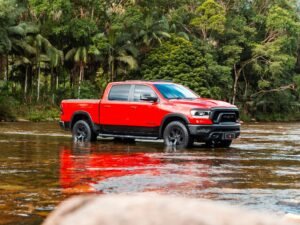
- Ford F-450 Super Duty sits at the top of the food chain. The 2025 Ford F-350 and F-450 models are able to tow up to an incredible 40,000 lbs when they’re equipped with the 6.7L Power Stroke Diesel engine and a gooseneck hitch.
- Ram 3500 is a long-time favorite among ranchers and haulers, the Ram 3500 with a 6.7L Cummins High Output engine can tow up to 37,090 lbs. The 2025 HD model is rated just slightly lower at 36,610 lbs but remains an absolute powerhouse.
- Chevrolet Silverado 3500HD / GMC Sierra 3500HD capable twins are able to tow up to 36,000 lbs.
- In looking at diesel versus Gas/hybrid, the engine you choose is what really dictates your capacity. Diesel engines consistently deliver the massive torque needed for those 37,000 to 40,000 lb loads. Gasoline models, like the Ram 2500, max out around 15,220 lbs. Hybrids, unfortunately, fall short in this category; the Ford F-150 Hybrid tops out at 12,400 lbs, making it unsuitable for serious heavy hauling.
Hitches, Trailers, and Safety Checks
All that power doesn’t mean a thing if you don’t have a secure connection. A chain is only as strong as its weakest link, and in the world of towing, that weak link is often the hitch.
Connecting the Load
- A standard Class V hitch will limit you to 20,000 lbs of Gross Trailer Weight (GTW). For any loads between 16,000 and 30,000+ lbs, you absolutely have to upgrade. A gooseneck hitch with a 2-5/16″ ball can support up to 30,000 lbs GTW and 7,500 lbs of tongue weight. This setup is so effective because it centers the weight over the truck’s rear axle, giving you much better control.
- Moving heavy equipment often calls for a tilt bed lowboy semi-trailer. These typically offer a 35-ton capacity. They can span from 40 to 48 feet and come equipped with a winch using 75 feet of 5/8” cable to pull machinery that isn’t running up onto the deck.
- Ignorance can cause accidents. It’s crucial that you verify the Gross Vehicle Weight Rating (GVWR) and Gross Axle Weight Rating (GAWR) on both the truck and the trailer. Exceeding these manufacturer-set limits is not only illegal but also incredibly dangerous.
The 6 Primary Types of Heavy-Duty Towing Equipment
- Just like any skilled professional, tow operators use specific tools for specific problems. Here is a quick breakdown of the different kinds of machinery you’ll see out on the road.
- Heavy-Duty Wrecker is the standard, go-to unit for towing big vehicles like semi-trucks, buses, and RVs. It works by lifting either the front or the rear of the vehicle that needs rescuing.
- The rotator is the largest and most capable machine available. It features a rotating boom that allows for 360-degree recovery operations. Its capacity often exceeds a massive 75,000 lbs.
- Flatbed (or Carrier) uses a hydraulic platform to carry vehicles. While heavy-duty versions do exist for larger equipment, standard models usually limit loads to around 5,000 lbs.
- Wheel-Lift tow trucks are fast and maneuverable. They use a metal yoke to lift a vehicle by its tires, which makes them very common in tight urban areas.
- Boom trucks feature a boom winch that’s used to recover vehicles from places like ditches. It doesn’t typically tow the vehicle away; its main job is just the recovery itself.
- Integrated tow truck design combines the boom and the wheel-lift into one cohesive unit. It has become the modern standard, with some models capable of lifting up to 50,000 lbs.
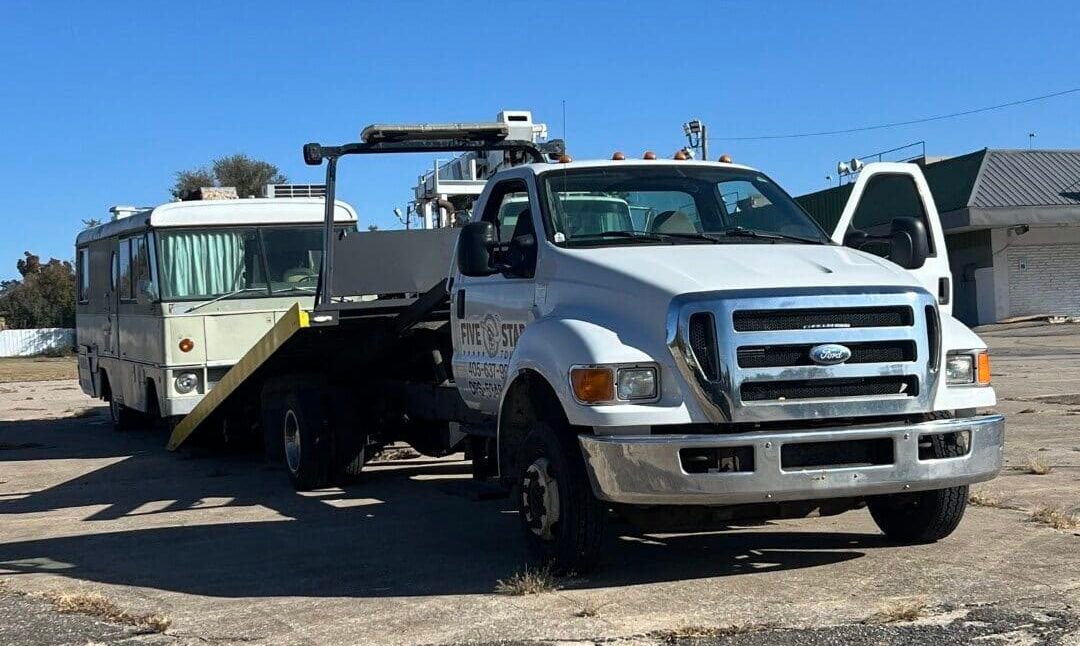
When your fleet is on the line, you simply can’t afford to settle for second-rate equipment or inexperienced operators. At Five Star Towing in OKC, we invest in top-tier heavy-duty wreckers and rotators to ensure your assets are recovered safely and efficiently. Whether you’re stuck on the turnpike or need a heavy haul across the city, we have the power to get you moving.
Frequently Asked Questions
Simply put, a heavy-duty tow truck is a recovery vehicle built for the big jobs. The official definition comes down to its Gross Vehicle Weight Rating (GVWR), which must be over 26,000 lbs. This classification legally separates it from its smaller light or medium-duty counterparts. These trucks are built on an incredibly sturdy Class 7 or Class 8 chassis, which provides the structural backbone needed to handle extreme loads.
The real-world meaning of this definition is all about capacity. While a standard tow truck might be fine for a sedan, a heavy-duty unit has the muscle to lift and tow commercial assets like semi-trucks, buses, and heavy construction machinery. As experts like Elite Towing point out, these trucks are specifically designed for complex recoveries where standard equipment would simply fail under the strain (Elite Towing; My Tee Products).
The biggest difference between them comes down to how the boom moves. A standard wrecker has a boom that lifts up and down but is fixed in place on the truck's chassis. A rotator, on the other hand, has a boom mounted on a turret that can spin a full 360 degrees. This unique feature allows the operator to lift and swing a massive load without having to reposition the truck itself.
This mobility completely changes the strategy for a recovery. Rotators are invaluable in situations where the tow truck can't get positioned directly in line with the disabled vehicle, like on narrow highway shoulders or bridge embankments. According to Miller Industries, the rotator's ability to swing heavy loads makes it the best tool for complicated accidents, especially those involving overturned tractor-trailers or recoveries that need crane-like precision (Miller Industries; Universal Towing Daytona).
The lifting capacity can vary quite a bit depending on the model, but generally, heavy-duty tow trucks can handle anywhere from 25 to 100 tons. Your standard heavy wreckers often fall into the 25 to 50-ton range, while the more specialized rotators can lift over 75 tons. It's really important to know the difference between towing capacity (the power to pull) and lifting capacity (the power of the winch and boom).
Understanding these limits is critical for preventing catastrophic equipment failure. For example, a 35-ton wrecker like the Century 1135 is perfect for most standard semi-truck tows. But a fully loaded cement mixer stuck in a ditch is a different story. That job would require the higher limits of a 75-ton unit. Sources like Top Mark Funding and Miller Industries emphasize that matching the truck's specific tonnage rating to the vehicle's weight is a safety rule that you can't afford to break (Top Mark Funding; Miller Industries).
A Class 8 truck chassis is a heavy-duty vehicle frame with a GVWR of over 33,000 lbs. In the United States, this is the heaviest classification for trucks that drive on the highway. These are the same chassis that serve as the platform for the biggest commercial vehicles on the road, including dump trucks, semi-tractors, and, of course, heavy-duty tow trucks.
Using a Class 8 chassis ensures that the tow truck has the necessary braking power, suspension stiffness, and engine torque to control a load that might even outweigh the tow truck itself. Without this solid foundation, the tow truck would be unstable and unsafe to operate on public roads. Information from Weigh-Safe and Elite Towing confirms that Class 8 is the industry standard for any vehicle that's intended to tow commercial transport trucks (Weigh-Safe; Elite Towing).
GVWR stands for Gross Vehicle Weight Rating. It's the maximum total weight a vehicle can safely operate at, as determined by the manufacturer. This number includes everything; the chassis, body, engine, fuel, accessories, driver, passengers, and any cargo. It's important to remember that GVWR doesn't include the weight of a trailer, but it does include the tongue weight and the downward pressure a trailer puts on the vehicle's hitch.
Ignoring the GVWR is a leading cause of mechanical failure and serious legal trouble. If a tow truck exceeds its GVWR because of the downward force from a heavy load on its underlift, its braking distance gets longer and its steering becomes less responsive. According to experts at Kelley Blue Book and Weigh-Safe, always staying within the GVWR is the first and most important step to a compliant and safe towing operation (KBB; Weigh-Safe).
Yes, certain heavy-duty pickup trucks are definitely engineered for heavy towing, though they're in a different class than commercial wreckers. Models like the Ford F-450 and Ram 3500 can tow between 35,000 and 40,000 lbs when they're properly set up with a diesel engine and a gooseneck hitch.
However, this capacity is mainly for hauling trailers, not for vehicle recovery. While a Ford F-450 can easily pull a heavy horse trailer or a flatbed with construction equipment, it just doesn't have the boom and winching gear of a dedicated wrecker. As detailed by Kelley Blue Book and the manufacturers themselves, these powerful trucks are designed to bridge the gap between consumer vehicles and commercial haulers (KBB; Agero).
The title of "strongest" tow truck usually goes to highly specialized rotators that are designed for extreme jobs in mining or the military. In the commercial world, rotators like the Miller Industries Century M100 are at the top, offering a lifting capacity of 100 tons (or 200,000 lbs). Some custom-built military and mining recovery vehicles are engineered to handle even more than that.
These incredible machines are quite rare and are saved for the heaviest industrial tasks imaginable. They represent the absolute peak of hydraulic engineering, capable of lifting something as massive as a locomotive or a mining dump truck. Sources from Miller Industries and Top Mark Funding describe these 100-ton units as the ultimate solution for the most extreme weight scenarios (Miller Industries; Top Mark Funding).
A gooseneck hitch is a type of ball hitch that gets mounted in the bed of a pickup truck, positioned directly over the rear axle. You'll need one for any load that's too heavy for a standard bumper-pull (Class V) hitch, which is typically anything over 16,000 to 20,000 lbs.
This setup provides far better stability than bumper towing. By placing the pivot point over the axle, it drastically reduces trailer sway and allows the truck to handle much more tongue weight up to 7,500 lbs or even more. It's the standard for hauling heavy equipment trailers, large RVs, and multi-car carriers. Both Weigh-Safe and Kelley Blue Book identify the gooseneck as a must-have upgrade for anyone looking to maximize the towing potential of their heavy-duty pickup (Weigh-Safe; KBB).
Side-pullers are specialized attachments or units that let a tow truck pull from the side, instead of just from the back. They usually work by deploying a stiff leg to the ground for stability, then using a winch system that's specifically routed for pulling at a side angle.
This capability is crucial when a vehicle is off the road in a spot where the tow truck can't back up to it directly. For instance, if a car has gone over a guardrail or down an embankment that runs parallel to the road, a side-puller allows the operator to winch it back onto the road surface from the shoulder. As Universal Towing and Miller Industries point out, equipment like the SP 850-XP often prevents the need for major lane closures that would be necessary if you had to position a standard wrecker perpendicular to traffic (Universal Towing Daytona; Miller Industries).
Miller Industries is the undisputed leader in the North American market, as they own major, well-respected brands like Century, Vulcan, and Holmes. These brands are known for their durability, their innovations in hydraulic systems, and their extensive service and support networks.
Going with a reputable brand like one of these ensures that parts will be available and that the truck will hold its resale value. Century is often praised for its powerful rotators, while Vulcan is known for its composite bodies and lightweight integrated units. Industry experts at Top Mark Funding and Elite Towing consistently name these Miller Industries brands as the gold standard for professional towing equipment (Top Mark Funding; Elite Towing).
A traditional boom truck is equipped with a winch and boom for lifting, but it might not have the wheel-lift mechanism needed to securely tow the vehicle away. An integrated tow truck, on the other hand, combines both the boom and the wheel-lift (or underlift) into a single, cohesive unit.
The integrated design is much more efficient and versatile. It allows an operator to lift a vehicle for recovery and then immediately secure it for transport without having to switch equipment. This integration also helps reduce the overall weight of the truck and improves its maneuverability. Experts at My Tee Products and Time Task Force explain that integrated trucks have largely replaced pure boom trucks for most roadway towing jobs because of this all-in-one capability (My Tee Products; Time Task Force).
The cost can vary dramatically depending on the specs, but a new heavy-duty wrecker generally starts at around $250,000 and can easily exceed $750,000 for a large, fully-equipped rotator. The chassis alone (from a brand like Peterbilt or Kenworth) can cost between $140,000 and $160,000, with the wrecker body making up the rest of the significant expense.
This high cost reflects the incredible amount of specialized engineering that goes into these machines. A used heavy-duty truck might go for $100,000 to $150,000, but the maintenance costs on older hydraulic systems can be substantial. Data from Top Mark Funding and general market listings show that buying a 50-ton rotator is a major capital investment, comparable to buying a piece of real estate (Top Mark Funding; Elite Towing).