
It’s a sight you never forget, an 80,000-pound semi-truck folding in on itself on I-35. The horrifying screech of tires gives way to the gut-wrenching crunch of metal, and then a silence that feels heavier than the wreckage itself. For drivers in Oklahoma City, this scene is all too familiar.
The highway grinds to a halt, traffic snakes back for miles, and first responders race toward a twisted heap of steel blocking lane after lane. These aren’t just traffic jams; they are violent lessons in physics, where the colossal mass of a commercial vehicle tragically overwhelms its own ability to stop.
Key Points
- A staggering 10% of all fatalities in trucking incidents are the result of jackknife accidents.
- It’s rarely the truck driver who is killed; 67% of victims in fatal truck crashes are people in passenger cars.
- The mechanical triggers are almost always a loss of traction combined with sudden, hard braking.
- Clearing the scene isn’t a simple tow; it requires heavy-duty rotators and highly specialized recovery expertise.
- Figuring out who is at fault often goes beyond the driver to include the trucking company or even the vehicle’s manufacturer.
Why Jackknife Accidents Are So Deadly
The sheer scale of a jackknife accident unleashes a level of catastrophic damage that a standard car crash simply can’t produce. While you might not see them as often as a fender bender, their power to kill is statistically undeniable. According to research from Vegas Valley Law, jackknife accidents are behind 10% of all trucking-related deaths. That figure is deeply alarming because it shows how one specific type of mechanical failure can have such fatal consequences. The physics involved create a devastating sweeping motion that wipes out anything in the truck’s path, catching other drivers who never had a chance to react.
Tragically, the victims in these horrific events are rarely the truck drivers themselves. Data from the Insurance Institute for Highway Safety (IIHS) reveals that 67% of those killed in fatal truck crashes are the occupants of passenger vehicles. When you expand that to include pedestrians and motorcyclists, the number climbs to over 70%. The brutal disparity in weight is the deciding factor. An 80,000-pound tractor-trailer is a force of momentum that a 3,000-pound car can never hope to withstand. Even a glancing blow from a trailer as it swings uncontrollably can be lethal.
Understanding the Surge in Fatalities
Recent trends show that this is a problem that’s getting worse, not better. The Martinez Law Firm points to a disturbing increase in severe incidents, which aligns with national data showing a 27% jump in fatal large truck crashes per million people between 2010 and 2020. In 2020 alone, a total of 4,965 people died in truck crashes. Of those, 169 deaths were from specific jackknife incidents. While jackknifes made up 3.5% of fatal crashes that year, their unique ability to trigger massive, multi-vehicle pileups makes them especially dangerous. A swinging trailer effectively becomes a moving barricade, often causing a chain reaction of secondary collisions that compound the horror of the initial impact.
Understanding the Mechanics of a Jackknife Truck Accident
A jackknife happens when the two parts of a semi, the tractor and the trailer stop working as a team. It all starts when the trailer swings out on its own, independent of the cab, forcing the entire rig to pivot and fold into a sharp “V” or “L” shape. The movement looks just like a pocket knife snapping shut, which is where the name comes from. The most terrifying part of this is the complete loss of control. Once the fold begins, the driver is no longer steering; they are just a passenger along for a horrifying ride, unable to correct the slide until the truck’s momentum finally runs out or it collides with an obstacle.
At its core, this mechanical failure is caused by a loss of traction. The drive wheels on the tractor, the ones that do the work of pulling the massive load, lose their grip on the road. At the same time, the heavy trailer keeps pushing forward with immense momentum. With the cab slowing down and the trailer still surging ahead, all that energy has to go somewhere and it goes sideways. This force turns the connection point (the kingpin) into a giant hinge. The truck’s high center of gravity only makes the slide worse, making it nearly impossible for the tires to grab onto the pavement again. Unlike a skid in a small car, which can often be corrected by steering, a jackknifing truck is a different beast. Once that fold passes a 15-degree angle, even the most seasoned drivers struggle to regain control.
The Top Causes Behind a Tractor-Trailer Fold
Sudden, hard braking is the main catalyst that sets most jackknife scenarios in motion. When a driver slams on the brakes, the wheels can lock up completely. If the tractor’s wheels lock but the trailer’s wheels keep rolling, the trailer will physically push the back of the tractor sideways. This imbalance in braking is the perfect recipe for a fold. As Stokes Stemle points out, this loss of synchronization between a slowing cab and a charging trailer is the number one mechanical cause. In a panic, our human instinct is to stop as fast as possible, but for the driver of a heavy hauler, that instinct often leads to disaster.
Here in Oklahoma, environmental factors can dramatically increase these risks. Black ice, sleet, and packed snow can turn our highways into skating rinks where traction is just a memory. Malm Legal notes that slick road surfaces are a huge amplifier, making it far more likely for the drive wheels to spin or lock up. Driving too fast for these conditions is a major contributing factor. A truck that handles perfectly at 55 mph on dry pavement becomes a different, more dangerous machine on an icy road, yet tight delivery schedules often pressure drivers to maintain speeds that are simply not safe for the weather.
Improperly loaded cargo also plays a quiet but deadly role. If the weight inside a trailer isn’t distributed evenly or properly secured, it can shift unexpectedly during the trip. A sudden shift in weight can throw off the truck’s center of gravity, forcing the trailer to swing wide during a turn or when braking. Combine that with malfunctioning ABS brakes or poor vehicle maintenance, and the margin for error completely vanishes. The Federal Highway Administration (FHWA) adds important context on the weather, stating that 24% of weather-related crashes happen on snowy, slushy, or icy roads, leading to over 1,300 deaths every year.
How Truck Drivers Can Prevent a Jackknife Incident
Prevention is an active, ongoing process that starts long before the engine is ever turned on. Diligent pre-trip inspections are a driver’s first and best line of defense. They must check their brake adjustments, look at tire tread depth, and measure tire pressure. A tire with worn tread can’t channel away water or grip onto snow, making a loss of traction almost inevitable. Making sure the Anti-Lock Braking System (ABS) is working perfectly is just as crucial, since a functioning ABS is what prevents the wheel lockup that starts the slide.
Once on the road, smart driving habits are what save lives. The single most effective tactic is to slow down a lot when conditions get bad. Momentum is the enemy of stability on slick roads. Increasing the following distance is also completely non-negotiable. Bey & Associates emphasizes the importance of following the Federal Motor Carrier Safety Administration (FMCSA) guidelines on safe distances. More space between vehicles means less need for the kind of sudden, hard braking that can cause a trailer to push the tractor into a fold.
Steps for Maintaining Control
- You should cut your speed by at least a third on wet roads, and by half or even more on packed snow.
- Never slam on the brake pedal. Instead, apply steady, light pressure to gently scrub off speed without locking up the wheels.
- If you feel the trailer starting to swing, gently steer in the same direction as the slide. This helps to realign the tractor with the trailer.
- Keep a constant eye on your trailer in your side mirrors. If you see it start to drift, you need to make immediate, subtle steering corrections.
- In severe winter weather, using chains can reduce slip by as much as 50%, giving you the grip you need to keep the drive wheels firmly planted.
The Complex Recovery Process for a Jackknifed Semi
Clearing a jackknifed semi-truck from the highway isn’t like a standard tow job; it’s a heavy-duty recovery operation that requires immense power and surgical precision. Because the truck is literally folded in on itself, it can’t just be pulled away. The tension between the tractor and the trailer has to be released with extreme care to avoid snapping the kingpin or, even worse, causing the whole rig to roll over.
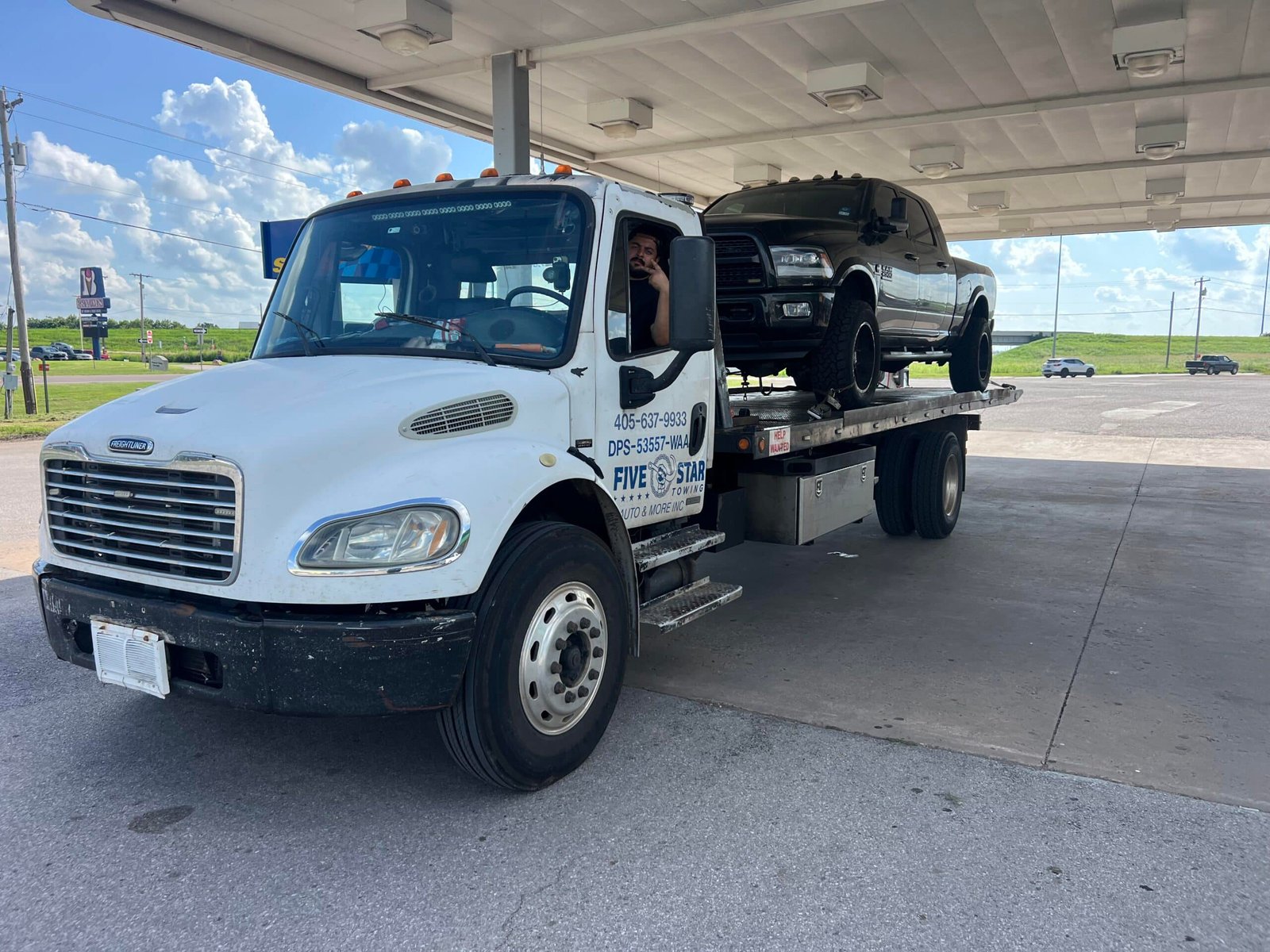
At Five Star Towing, we bring out our heavy-duty wreckers and rotators for these exact situations. A rotator, with its crane-like boom that can spin 360 degrees, lets our operators lift and reposition the massive tractor or trailer from the perfect angle, all without dragging the wreckage and causing more damage.
The first thing our recovery team does is secure the scene to protect other drivers and our crew. Scene control and hazard assessment are key parts of our semi-truck incident safety protocols. We then have to assess the stability of the cargo inside the trailer. If the load has shifted, trying to upright the truck could cause the trailer walls to burst open. Once the scene is stable, our operators use a system of winches and boom lines to carefully pull the tractor and trailer back into alignment.
This often involves lifting the tractor’s drive axles off the ground while simultaneously pulling the rear of the trailer to straighten out the articulation point. In the most severe cases, where the truck has gone off the road or completely overturned, we may deploy cranes to lift the entire unit. All of this work happens under intense pressure, because clearing I-40 or I-35 is a top priority for keeping Oklahoma City moving.
Determining Fault in a Jackknife Collision
Figuring out who is liable in these crashes is rarely a simple matter. While all eyes are initially on the driver behind the wheel, the responsibility often spreads much wider. Zehl Law explains that liability can be placed on several different parties, depending on what really caused the accident. If the driver was speeding, ignoring weather warnings, or tailgating, then they are clearly negligent.
However, if the driver was following every safety rule and the brakes failed because of poor maintenance, the motor carrier is most likely at fault. Trucking companies have a legal duty to maintain their fleets and make sure all mechanical systems, especially brakes and tires, are safe for the road.
Systemic problems can also point directly to corporate negligence. If a trucking company pressures a driver to meet an impossible delivery schedule, forcing them to speed through a blizzard or skip mandatory rest breaks, that company shares in the liability. Even vehicle manufacturers can be held responsible if a defective part, like a faulty ABS sensor or a tire that blows out, is what caused the loss of control.
Flick Truck Accident Law notes that crucial evidence like dashcam footage, telematics data (from the truck’s “black box”), and FMCSA inspection logs are vital in these investigations. This data can reveal hard braking events, the truck’s speed at the moment of impact, and whether the driver was complying with hours-of-service rules, painting a clear picture of who or what is truly to blame. Regardless of who may be liable, keeping the area safe after a jackknife crash is an immediate priority. Our crash scene safety tips cover important steps for staying safe around a serious collision.
Frequently Asked Questions
The most common reason a truck jackknifes is because the drive wheels on the tractor lose their grip on the road. This usually happens because of sudden, hard braking or even accelerating too quickly on a slippery surface. When those drive wheels lock up, the unstoppable momentum of the heavy trailer keeps pushing forward, forcing the tractor sideways and starting the fold.
Bey & Associates identifies braking errors as a top factor, especially when the tractor's brakes are applied harder than the trailer's brakes. Stokes Stemle agrees, highlighting that equipment failures like a brake imbalance often contribute to the loss of control.
This all underscores how critical it is for drivers to avoid panic braking. Using proper braking techniques and keeping the entire braking system perfectly maintained are the best ways to prevent the loss of traction that can lead to catastrophe.
Ice and snow dramatically reduce the friction between a truck's tires and the road. On dry pavement, tires have a strong grip that allows a massive truck to steer and stop safely. On ice, that grip practically disappears. If the drive wheels can't grab the road, the trailer's forward energy will instantly push the tractor out of alignment the second the driver tries to slow down or speed up.
Malm Legal emphasizes that winter conditions are a major catalyst for these accidents because they totally compromise the rig's stability. Data from the FHWA backs this up, showing that 24% of weather-related crashes occur on snowy or icy pavement, which directly links low traction to high accident rates.
Any driver operating in an Oklahoma winter has to drive with the assumption that traction is limited. This means that normal driving habits like speed, following distance, and how you apply the brakes have to be completely changed to make up for the treacherous road conditions.
While the truck driver is always the first person to be investigated, fault very often lies with the trucking company, also known as the "motor carrier." The driver might be held responsible for speeding or making a poor decision, but the carrier is responsible for the condition of the truck and the schedule they force the driver to keep.
Zehl Law points out that investigations into liability often uncover that poor maintenance or pressure to drive in unsafe conditions were the real root causes. Flick Truck Accident Law adds that proving fault requires digging into logbooks and maintenance records, which frequently shifts the blame from the individual driver to negligence at the corporate level.
This is why victims of these accidents should never assume the driver is the only party responsible. A thorough legal investigation can uncover systemic failures within the company that played a major role in causing the crash.
Your standard tow truck is no match for a jackknifed semi. The recovery demands a heavy-duty wrecker or, ideally, a rotator. These specialized vehicles are equipped with powerful boom lifts, industrial-strength winches, and stabilizing outriggers capable of lifting and pulling tens of thousands of pounds safely.
We use this kind of specialized equipment because the folded geometry of a jackknifed truck often wedges it in a way that simply pulling on it would cause even more damage. As Flick Truck Accident Law notes, a proper recovery prevents further damage to the vehicle and the road itself.
Trying to use the wrong equipment can snap tow lines or cause the entire truck to roll over. Only certified heavy-duty recovery specialists have the right tools and the extensive training needed to safely untangle a folded tractor-trailer.
Yes, thankfully, modern trucks are being equipped with advanced stability control systems. Technologies like Electronic Stability Control (ESC) and Roll Stability Control (RSC) constantly monitor the truck's movement. If their sensors detect a loss of directional control or that a wheel is lifting off the ground, the system can automatically apply the brakes to specific wheels to help realign the vehicle.
Studies from the IIHS show that these technologies have significantly reduced the number of loss-of-control crashes. However, The Martinez Law Firm also mentions that while these systems are incredibly effective, they can't defy the laws of physics or make up for extreme driver negligence in severe conditions.
This technology should be seen as a safety net, not a replacement for skilled driving. While ESC can certainly help, it doesn't eliminate the need for safe driving practices and meticulous vehicle maintenance. Relying on technology alone is a risk that no one should take.
A jackknife accident on an OKC road unleashes chaos, danger, and confusion for everyone involved. Whether you're a driver in need of recovery or a motorist caught in the aftermath, getting professional help is absolutely vital.
Five Star Towing provides the heavy-duty expertise needed to clear these massive wrecks safely and get traffic moving again. We're proud to keep Oklahoma City moving, one recovery at a time.