
That distinct click of the pump nozzle usually signals a job well done. But sometimes, a glance down at the handle triggers a wave of cold sweat. You grabbed the green one instead of the black one. You just pumped diesel into your gas car, or maybe gas into your diesel truck. Your stomach plummets. At that moment, you probably feel like the only person in Oklahoma City who has ever made this mistake. Trust us, you aren’t.
You have a very short window to keep a simple inconvenience from spiraling into a mechanical catastrophe. The choices you make in the next sixty seconds can be the difference between paying for a tank drain and paying for a whole new engine. So, take a deep breath, and whatever you do, keep the key out of the ignition. Here at Five Star Towing, we handle this situation all the time, and we know exactly what to do to get you safely back on your way.
Key Points
- Turning the key is the costliest mistake you can make. It circulates the wrong fuel and causes serious damage.
- If you can, put the car in neutral and push it to a secure spot away from the pumps.
- Take note of whether you put gas in a diesel engine or vice versa; the consequences are different.
- A professional fuel drain is far cheaper than replacing an engine.
- Most standard insurance policies don’t cover misfuelling, so it’s wise to see if you have any special add-ons.
What to Do Immediately After Putting the Wrong Fuel in Your Car
Step 1: Don't Panic and DON'T Start the Engine
The single most important rule is also the simplest, do not turn that key. Don’t even put it in the ignition and turn it to the “on” position to roll down your windows or listen to the radio. Modern cars have electric fuel pumps that start to prime the system the second the ignition is engaged. If that pump kicks on, it will send a stream of the wrong fuel shooting through your fuel lines, your filter, and right into the heart of your engine.
By keeping the engine off, you contain the problem to the fuel tank, which is a relatively easy fix. A tank drain is a straightforward procedure for a professional. But once that contaminated fuel enters the intricate, high-pressure system of a modern engine, the repair job goes from a simple flush to a complex and expensive overhaul. Even if your engine is hot and you’re tempted to move the car just a few feet, resisting that urge will save you thousands of dollars. Leave the key in your pocket.
Step 2: Secure Your Vehicle and Alert Staff
You need to get your car away from the pump without starting the engine. The best way is to put the transmission in neutral. If you have a passenger or if a kind stranger offers to help, you can push the vehicle to a safe parking spot, out of the way of other drivers. Your goal is to clear the pump for others while you sort things out.
Once the car is moved, go inside and let the gas station attendants know what happened. Tell them you’ve put the wrong fuel in your car and that it can’t be started. Don’t worry, the staff has seen this happen before. They can help you by placing cones around your vehicle if it couldn’t be moved, keeping everyone safe and preventing other drivers from getting stuck behind you.
Step 3: Call for Professional Roadside Assistance
This isn’t a problem you can solve with a garden hose and a gas can. Modern fuel tanks are often built with anti-siphon devices that make it nearly impossible to drain them yourself. You need a specialist. Call a dedicated mobile fuel draining service or your trusted roadside assistance provider right away. Be very clear about the problem. Tell them, “I put the wrong fuel in my car.”
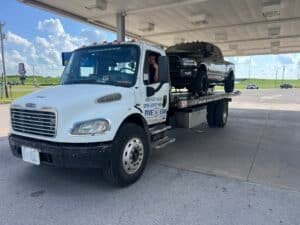
Around the world, entire fleets are dedicated to this exact problem. For instance, the RAC in the UK has over 30 specialized vans just for misfuelling calls, and companies like Fuel Fixer have technicians who can perform the drain right there on the roadside. Here in Oklahoma City, that’s where a local expert like Five Star Towing comes in. We can provide the tow you need to get your car to a shop, or we can help arrange for a drain, making sure the contaminated fuel is removed responsibly before it has a chance to ruin your engine.
What Happens When You Mix Gas and Diesel
Petrol in a Diesel Engine
Putting gasoline (petrol) into a diesel engine is the worst-case scenario for your vehicle. You see, diesel fuel does two jobs, it’s a fuel, but it’s also a lubricant. It keeps all the internal components of the fuel pump and injectors moving smoothly. Gasoline, on the other hand, acts as a solvent.
When you introduce gasoline into a diesel system, it strips away that vital lubrication. Think of it like running an engine with no oil. This causes metal-on-metal friction inside the high-pressure fuel pump. The pump can quickly begin to tear itself apart, sending tiny metal shavings all through your fuel lines and clogging the injectors. The damage is often catastrophic, leading to severe engine misfires and, eventually, complete engine failure. As industry experts often note, the repair bill for this kind of damage can run into the thousands of dollars if the system isn’t drained immediately.
Diesel in a Petrol Engine
Putting diesel into a gas (petrol) engine is usually less destructive, but it’s still a serious problem. Diesel is a much heavier, oilier substance that doesn’t evaporate like gasoline. Because it’s so thick, it has a tendency to clog up the more delicate components of a gasoline fuel system.
Imagine trying to push honey through a tiny straw, that’s what diesel does to your engine’s parts. The spark plugs and fuel injectors will quickly get gummed up. If you manage to start the engine, it will likely produce a lot of thick smoke, run very poorly, and then stall out as the spark plugs become too fouled to create a spark. The engine simply can’t ignite the heavy diesel fuel. While you probably won’t destroy the engine block, the entire system will need a professional drain and flush to get rid of all that oily residue. You can’t just top it off with good gas to dilute it; the contamination is just too thick to overcome.
Unpacking the Cost of a Misfuelling Mistake
The Average Cost for a Fuel Drain and Flush
If you catch your mistake before starting the engine, your wallet will definitely take a hit, but it should survive the ordeal. Based on industry data, the average cost for a professional fuel drain and flush is around $250. This price typically covers the technician’s visit, the labor involved in draining the tank, and the proper, environmentally-safe disposal of the contaminated fuel.
Of course, you’ll also lose the money you just spent on the tank of bad fuel, which usually adds up to another $65 or so. While it’s frustrating to be out a few hundred dollars, it’s a much better outcome than the alternative. If you haven’t started the car, this is usually the end of the financial pain.
Engine Repair Bills Explained
The moment you turn that key, the price tag on this mistake explodes. If you drive the car until it sputters to a stop, you’re no longer looking at a simple drain. You’re looking at replacing fuel pumps, injectors, filters, and in the worst-case scenarios, the entire engine. Repair costs can easily climb into the thousands, ranging from $500 to over $5,000, depending on your vehicle’s make and model.
The collective impact of these simple mistakes is enormous. To give you an idea, in the UK alone, the total annual cost of misfuelling is estimated to be over $50 million. Interestingly, studies show men account for a larger portion of these costs. This isn’t just a personal headache; it’s a multi-million dollar problem built on a moment of human error.
Will Your Insurance Cover a Wrong Fuel Incident?
Don’t just assume your comprehensive car insurance policy will bail you out of this one, because it’s very unlikely. Standard car insurance policies almost never cover damage that results from putting the wrong fuel in your car. When you look at the data, only about 14% of policies cover this kind of damage as a standard feature, and a mere 3% offer it as an optional add-on.
A staggering 83% of insurance policies have language that specifically excludes misfuelling from their coverage. Insurance companies tend to see this as a preventable error, more like a maintenance issue than an accident. Some providers offer specific “Misfuel Rescue” coverage as a separate product you can buy, but unless you’ve specifically asked for and purchased this add-on, you’ll almost certainly be paying for the repairs out of your own pocket.
Shocking Statistics on Misfuelling
How Common is Putting the Wrong Fuel in a Car?
If you’re standing on the side of the road reading this on your phone, you might feel a bit foolish. Please don’t. Misfuelling is an incredibly common mistake. Studies show that about 1 in 5 drivers (20%) admit to having put the wrong fuel in their car at least once in their lives.
To put that into perspective, this mistake happens to approximately 130,000 drivers in the UK every single year. Roadside assistance services see this every day; a single provider like the RAC handles over 30,000 of these calls annually. It’s estimated that a misfuelling incident occurs for every 3,000 fuel-ups. It’s a simple statistical reality of our busy lives.
Demographics of Misfuelling
The data reveals some interesting trends about who is most likely to make this mistake. Statistically, men are more likely than women to misfuel their vehicles. Studies show 24% of men admit to making this error, compared to 17% of women. Furthermore, men are also more likely to be repeat offenders, with 6% admitting to doing it more than once, versus only 4% of women.
Age also seems to play a factor. Younger drivers, who might be more easily distracted or less familiar with different types of vehicles, are at a higher risk. One in four (25%) drivers between the ages of 25 and 34 have misfuelled, compared to just 14% of drivers aged 45-54. At the end of the day, a moment of distraction can affect anyone, no matter how long they’ve been driving.
How to Prevent Putting the Wrong Fuel in Your Car
Simple Habits to Avoid a Costly Mistake
As the old saying goes, an ounce of prevention is worth a pound of cure. The vast majority of drivers (76%) manage to avoid this mistake their entire lives by developing a few simple habits. The most powerful tool you have is simply being mindful at the pump. We often fill up on autopilot, our minds drifting to work, dinner plans, or the kids.
- Don’t just go by the color of the handle. Take a second to read the grade on the pump itself.
- Many cars have the required fuel type written directly on the fuel cap or on a sticker inside the fuel door.
- Be extra careful if you’ve recently bought a new car, are driving a rental, or have borrowed a friend’s vehicle.
Is Misfuelling Insurance Worth It?
Considering that 83% of standard insurance policies won’t cover this damage, it’s a good idea to review your documents. If you frequently drive multiple vehicles that use different fuels like a diesel work truck and a gasoline-powered personal car, your risk of a mix-up is much higher. You might want to consider adding specific misfuelling coverage if your insurance provider offers it. It can provide valuable peace of mind, ensuring that one moment of distraction won’t end up draining your savings account.
Putting the wrong fuel in your car creates a sinking feeling in your stomach, but it doesn’t have to turn into a financial disaster. The difference between a minor service bill and a completely destroyed engine comes down to one simple action, keeping that ignition key turned off. If you’re in the Oklahoma City area and realize you’ve made this mistake, know that you have a reliable partner ready to help. Five Star Towing offers prompt, professional towing and assistance services all across OKC. We understand the urgency of the situation and have the know-how to get your vehicle handled safely so you can get back on the road. Don’t risk your engine; give Five Star Towing a call right away.
Frequently Asked Questions
If you've already started the engine, you'll feel a loss of power and rough acceleration almost right away. A gas car running on diesel might put out a lot of smoke, while a diesel car with gas will make a loud, clattering noise because the fuel is igniting at the wrong time.
The engine is struggling because it can't burn the fuel mixture properly. In a gas engine, the oily diesel keeps the spark plugs from firing. In a diesel engine, the volatile gasoline messes up the combustion timing.
Pull over safely as soon as you can. If you keep driving until the engine dies completely, you'll cause much more severe damage to the fuel pump and injectors.
If you haven't started the engine, a professional fuel drain usually costs around $250. This service includes draining the tank and flushing the lines to get everything clean.
The price will go up if you drive the car, because now the entire fuel system (lines, filter, and fuel rail) needs to be thoroughly cleaned. You'll also be out the money for the tank of fuel you just bought, which is typically about $65.
Paying for a tow and a professional drain is always the cheaper option compared to risking thousands in engine damage. Don't try to save a little money by driving "just a few miles" to get home.
Putting gasoline (petrol) in a diesel car is definitely the more serious mistake.
Diesel fuel also works as a lubricant for the high-pressure fuel pump. Gasoline is a solvent, and it strips that lubrication away. This causes the pump to grind itself into pieces, sending metal fragments throughout the engine. Putting diesel in a gas car, on the other hand, usually just clogs the system and fouls the spark plugs without destroying the engine itself.
Both situations require a professional drain, but a gas-in-diesel mix-up has the highest risk of completely totaling your engine if you turn the key.
No. It is never safe to drive your car with any amount of the wrong fuel in the tank.
You might hear that a small mix (under 5%) can be diluted by topping off the tank with the right fuel. However, modern common-rail diesel engines are extremely sensitive and can be damaged by even trace amounts of gasoline, which robs the system of lubrication.
Don't roll the dice. Even a small amount of gasoline can lower the flashpoint of diesel and lead to internal engine damage. It's always best to get the tank drained, no matter how little you put in.
Probably not. The data shows that a whopping 83% of standard policies specifically exclude misfuelling.
Only about 14% of policies include this kind of protection as a standard feature. Insurance companies often classify this as "accidental damage" but then write specific exclusions for it, viewing it as a preventable error.
Read the fine print of your policy and look for the words "misfuelling" or "wrong fuel." If you don't see it covered, you'll be responsible for the costs unless you've purchased a special add-on for it.
A professional roadside fuel drain is usually completed in about 30 to 60 minutes.
The technician will use a specialized suction device to safely remove the contaminated fluid from your tank. They will then flush a small amount of fresh, clean fuel through the system to clear out any remaining residue.
Mobile services can do this right where you are, which saves you the extra time and money it would take to tow your vehicle to a garage.
In most modern cars, no. You generally can't just stick a hose in the tank and siphon the fuel out.
Car manufacturers install anti-siphon screens and rollover valves in the filler neck. These are designed to prevent fuel theft and stop leaks in an accident, and they will block a siphon hose.
Trying to force a hose down there can damage the delicate sensors or the anti-siphon valve itself, creating another expensive repair. It's best to leave this to professionals who have the right tools to access the tank safely.
Yes, putting the wrong fuel in your car will almost certainly void the manufacturer's warranty for your fuel system and engine.
Warranties are there to cover defects in how the car was made, not mistakes made by the owner. Any damage caused by using the wrong fluids is considered an operator error.
If you drive the car and cause serious damage, the manufacturer will likely deny the warranty claim. This makes it absolutely critical to get the tank drained before you start the engine, which can help protect your warranty status.
The second you realize your mistake or hear the engine start to sputter and struggle, turn it off.
Do not try to restart it, not even for a second. Every time the engine turns over, it pumps more of the contaminated fuel into its most sensitive parts.
Call a tow truck. The car needs to be taken to a repair shop where a mechanic can professionally drain the tank, replace the fuel filter, and flush the entire fuel line system.
Yes, there are aftermarket fuel caps and devices you can buy that physically stop you from making this mistake. For example, they can prevent a narrower gasoline nozzle from fitting into a wider diesel filler neck.
These devices, like the Ford Easy-Fuel system that comes standard on some cars or third-party caps like the "Solo Diesel," are very effective and simple safety measures.
Absolutely. When you consider that the average misfuelling incident costs over $300 to fix, spending $50 on a prevention device is a smart move, especially for households with both gas and diesel vehicles.
It's incredibly common. In the UK, it happens about once every three minutes, with around 150,000 drivers making this mistake every year.
Men are slightly more likely to do it (24%) than women (17%), often because they're switching between a work vehicle and a personal car that use different fuels.
You're now part of a very large, unofficial club. This is a common lapse in concentration that can happen to anyone, not a sign that you're a bad driver.
Your standard breakdown cover will usually pay to tow you to a nearby garage, but it likely won't cover the cost of the fuel drain itself.
Some providers, like the RAC, have special vans that can perform a fuel drain right on the spot, but this is often an extra service that comes with a separate fee, unless you've paid for a premium plan.
Check with your provider to see if your roadside assistance plan includes "misfuel rescue" or if it only covers basic "recovery." Knowing the difference will tell you whether you'll be paying for the drain out of pocket.