
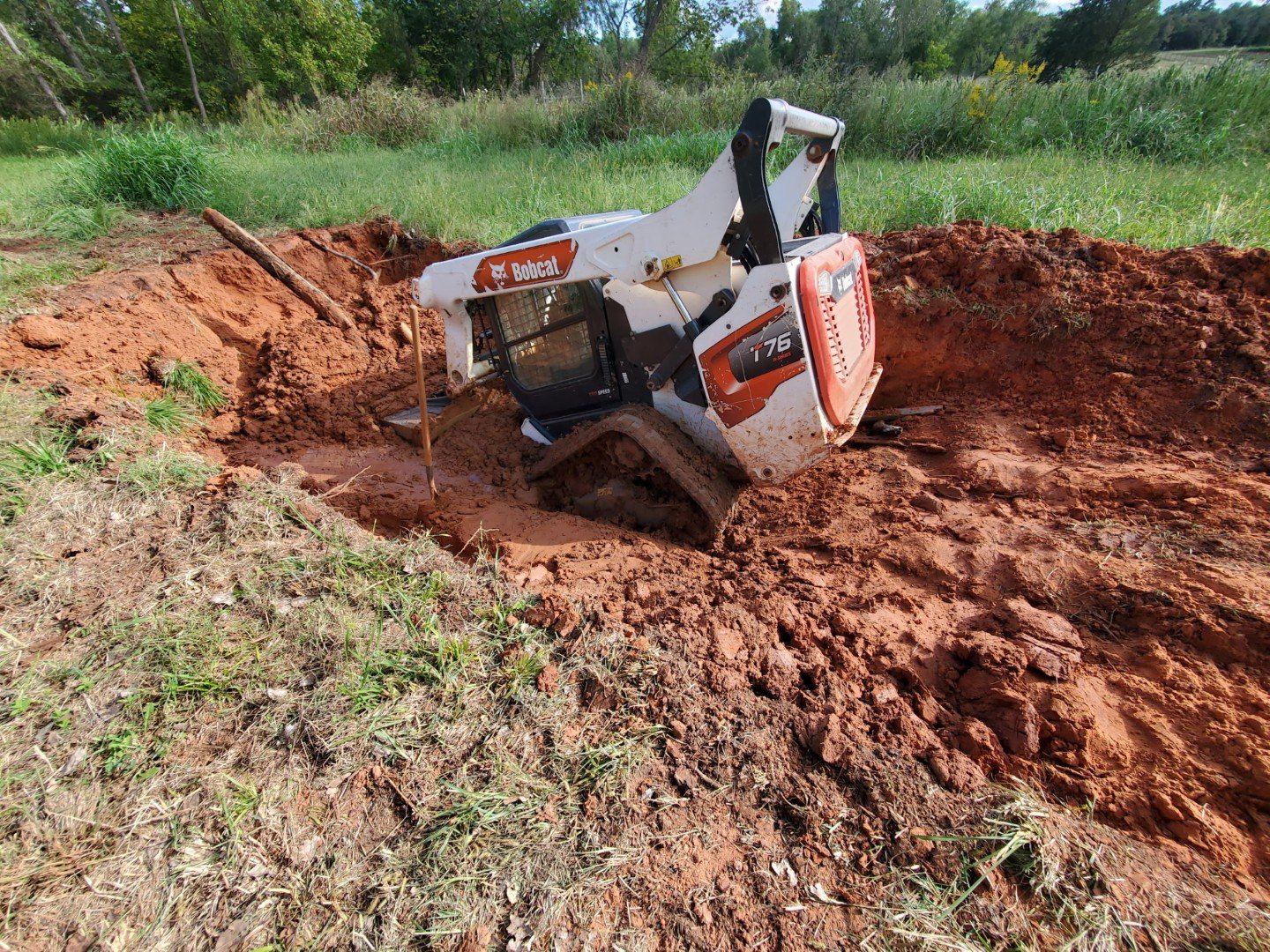
You hit the gas, but the horizon doesn’t budge. The engine screams, the wheels spin, and that sick feeling in your stomach confirms what your tires already know; you’re stuck. Whether you’re bogged down in the loose red dirt of an Oklahoma backroad or the deep, sucking silt of a riverbed, panic is your worst enemy, but action is your best friend.
This guide is here to cut through the noise and give you the real-world advice you need to get moving again, using a little bit of physics, the right gear, and techniques that have been proven time and time again.
Key Takeaways
- The moment you’re stuck, stop. Flooring it only digs you a deeper grave and creates more suction.
- Lowering your tire pressure is the single most effective trick in the book to help your vehicle “float” on top of soft ground.
- Before you try pulling, clear the mud and gunk from your wheels and undercarriage. This dramatically reduces the force needed for a successful recovery.
- A truck buried in deep mud can effectively double its weight, meaning your recovery gear needs to handle 100% of your vehicle’s mass.
- Never shock load a strap. The kinetic energy can generate over 6,000 kg of force, enough to be lethal if something breaks.
- When self-recovery isn’t working, calling in the pros isn’t giving up; it’s protecting your vehicle from serious damage.
A Step-by-Step Extraction Guide
This is where most drivers go wrong, usually in the first ten seconds. They feel the truck lose traction, and their gut reaction is to floor it. In doing so, they turn what could have been a minor inconvenience into a full-blown recovery mission. The second your forward momentum dies, your entire mindset has to switch from “driving” to “extracting.”
Stop Spinning and Assess the Situation
Your very first move is simple, lift your foot off the gas pedal. Stop accelerating, right now. Continuing to spin your wheels is like using them as rotary excavators, digging your tires deeper and deeper into the muck. Now, get out of the vehicle and take a hard look at the ground. You need to figure out just how bad the situation is.
If your truck is bogged down to the rims, you’re facing a resistance equal to your vehicle’s Gross Vehicle Mass (GVM). In plain English, that means you’ll need up to 100% more force to pull it free. A 5,000-pound truck buried to its axles now feels like a 10,000-pound weight to your recovery gear. Recognizing this early helps you choose the right tool for the job.
Lower Tire Pressures for Maximum Flotation
It’s time to air down your tires. This isn’t some off-road secret; it’s the single most effective first step you can take in any soft-surface recovery. When you lower the tire pressure, you dramatically increase the tire’s footprint. This lengthens the contact patch, helping it float on top of the sand or mud. You’re essentially trading a little bit of ground clearance for a whole lot more surface area. Deflating to around 20-25 psi is a sweet spot that gives you a major traction boost without running a high risk of popping the tire bead off the rim. Many drivers are hesitant to do this, but a wider tire stays on top of the mess instead of cutting right through it.
Dig Out Your Wheels and Undercarriage
Seriously, grab a shovel. Before you even think about hooking up a strap or unspooling a winch, you have to clear a path. Dig out the sand or mud from in front of and behind all four tires. You also need to clear out anything packed against the undercarriage. If your vehicle is “high-centered” meaning its weight is resting on the frame or differentials instead of the tires. Your wheels have already lost the friction battle. Real-world tests have shown that just two minutes of digging around a stuck Land Rover Defender in sand drastically cut the amount of force needed to recover it. Digging isn’t just about moving dirt; it’s about breaking the suction that’s holding your vehicle hostage.
Use Recovery Boards for Traction
Once you’ve cleared the way, it’s time to give your tires something to bite into. Wedge your recovery boards or traction mats firmly under the front of your drive wheels. Now, tell the driver to put it in gear and accelerate gently. The goal here is to climb onto the boards, not spin wildly on top of them. Spinning your wheels on the plastic can actually melt the board’s lugs, making them useless for the next time. Recovery boards act like a portable bridge, spanning the gap between the soft muck and solid ground, giving your tires the grip they need to build momentum again.
The Essential Gear for Any Sand or Mud Recovery
A successful recovery almost always comes down to having the right tools on hand before you leave the pavement. Relying on wishful thinking or a rusty old tow rope often leads to broken equipment or, even worse, a vehicle that’s still stranded. A well-stocked kit can turn a potential disaster into a story you tell your friends later.
Winches, Straps, and Pulleys
A winch is your ultimate lifeline when your tires have completely given up the fight for traction. Make sure your winch is rated for a minimum of 9,500 lbs, which is strong enough to handle the 80-120% load of a typical 4×4’s weight. Brands like Warn are legendary for their consistent, reliable pulling power. But remember, a winch is only as strong as the rigging connecting it to the anchor point. Always use high-quality snatch straps rated for heavy loads. For instance, Rhino USA snatch straps boast a capacity of over 30,000 lbs, which gives you the crucial safety margin you need to prevent a catastrophic snap.
This is also where a little high school physics becomes your best friend. Pulleys, often called snatch blocks in the off-road world, let you change the direction of your pull or, more importantly, increase your mechanical advantage. A single pulley can literally double your winch’s pulling power, which means the load on your winch motor is cut in half. While you can create some incredibly complex rigging setups, a simple single pulley is more than enough for 99% of the sticky situations you’ll encounter.
Your Best Friend When Stuck
Sometimes you don’t need a pull from another vehicle; you just need to create a little patch of solid ground for yourself. This is where recovery tracks like Maxtrax or X-Bull traction boards are worth their weight in gold. They give your tires a non-slip surface to grab onto in mud, sand, or snow. They’re lightweight, incredibly easy to use, and work wonders even if you’re stuck all by yourself. For the really deep, sloppy mud where your tire lugs instantly clog up, a good set of tire chains can serve as an aggressive traction aid, clawing through the slime to find harder earth underneath.
The Underappreciated Tools
Never underestimate the power of good old-fashioned manual labor. A quality shovel isn’t just a suggestion; it’s a non-negotiable part of any recovery kit. Clearing away material from your tires directly reduces the force needed to get the vehicle moving. And if your chassis is sitting on the ground, a jack becomes absolutely essential. For a high-centered vehicle, use the jack to lift it up by a solid armor point or bumper. Then, you can use the “double-lift” method; lift the vehicle, push the jack sideways to drop the vehicle onto fresh ground next to the rut, and then repeat the process. This simple technique can effectively shift your tires out of the trenches they dug for themselves.
Calculating Recovery Forces
A vehicle recovery isn’t a guessing game; it’s a physics equation. If you take a moment to understand the forces at play, you can select equipment that will hold up under pressure instead of failing when you need it most. When you pull a truck, you’re not just fighting its curb weight; you’re also battling gravity, friction, and the powerful suction of the mud itself.
How Much Force Does It Really Take?
The amount of force it takes to free a stuck vehicle can vary wildly depending on the terrain. In your average sand and mud, you can expect the recovery force to be somewhere between 30% and 80% of your vehicle’s total weight. So, a 4,000 kg vehicle stuck in sand needs a baseline pull of at least 1,200 kg (30%). But conditions can change that math in a hurry. In deep, suction-cup mud where the tires are completely buried, that vacuum effect can increase the load dramatically. The forces here can easily reach 80-100% of the vehicle’s weight. In some rare, extreme bogs, the force required can even exceed 200%.
The Recovery Formula
The pros use a specific formula to figure out the minimum recovery capacity needed: W (vehicle weight) + ARR (additional rolling resistance) + AGR (additional gradient resistance). Gravity is always fighting you on an incline. For example, a 42,000 lbs vehicle stuck in snow on a 15° slope requires this formula to determine the true pulling force. If that slope gets steeper, say to a 20° hill, the gradient forces jump by 34-42%. On top of that, you have to add another 3-4% for rolling resistance. Ignoring these variables is a recipe for a stalled-out winch or a snapped recovery line.
The Critical Difference
The driver in the stuck vehicle plays a huge part in this calculation. Pulling a vehicle that’s in neutral is like pulling dead weight; it means your gear has to overcome roughly 80% of its total weight. However, using “drive assist” where the driver gently applies the throttle to around 1,500 RPM can reduce the required pulling force by a massive 30-50%. Real-world tests show this clearly, one static pull of a vehicle in neutral registered a force of 1,714 kg, but the exact same pull with drive assist dropped the load all the way down to 1,560 kg. Helping the winch is helping your gear survive the recovery.
How to Avoid Getting Stuck in the First Place
The best recovery is the one you never have to do. Your success or failure on the trail often comes down to the four small patches of rubber connecting your vehicle to the ground. Smart preparation begins in your garage, not when you’re already stuck.
Choosing the Right Treads for the Terrain
Think of tires like shoes. You wouldn’t wear dress shoes to go hiking, and the same logic applies here. Mud tires are designed with wide, large, open lugs for a reason, they’re self-cleaning. As the tire spins, centrifugal force slings the mud out of the treads, preventing them from turning into a useless, smooth slick. The BFGoodrich Mud-Terrain is a classic example of this design. However, those same aggressive lugs can become a liability in sand, where they tend to dig straight down instead of floating. On the other hand, road-friendly treads do better in sand but fail miserably in mud.
As a general rule, wider tires help with flotation by spreading the vehicle’s weight over a larger area. The ground you plan to cover should dictate the rubber you choose, as terrain resistance varies wildly. It is about 13% on grass, 30% on sand, and a whopping 60% on clay or mud.
Your Post-Recovery Vehicle Checklist
Getting out of the mud is only half the battle. After any recovery involving deep mud or water, you have a critical inspection to do. First, check and clear the component breathers for your differentials and gearbox. If these get clogged, the cooling differentials can create a vacuum and suck water in through the seals, which will absolutely destroy your gears. Next, clear out all the mud caked under your wheel arches; when that clay dries, it acts like a concrete brake pad. You also have to clean the mud out of your wheel rims. Even a small clump of dried mud can throw your wheels out of balance, causing a violent vibration at highway speeds. Finally, check all the drain holes in your vehicle’s frame and body to make sure water can escape and prevent rust from setting in.
Critical Safety Mistakes That Cause Recoveries to Go Wrong
A vehicle recovery isn’t just challenging; it can be downright dangerous. The forces involved are more than enough to kill or maim if that energy is mismanaged. Most accidents happen because of impatience or a simple lack of understanding of the physics of kinetic energy.
The Danger of Shock Loading and Sudden Stops
Momentum is your friend, right up until it isn’t. If a vehicle is being snatched out and that momentum is brought to a sudden halt, the deceleration generates an immense amount of force. In one documented test, a sudden stop generated a staggering 6,371 kg of force, causing the recovery strap to stretch an extra 1.8 meters. That energy has to go somewhere, and if a strap or a metal recovery point fails, it becomes a deadly projectile. Similarly, trying to muscle a vehicle out after it has stopped and settled is pointless.
The friction coefficient of sand alone can add another 1,200-1,800 kg of resistance. If the pull stalls, stop, reset your rigging, and dig some more.
Incorrect Angles and Mismatched Gear
Geometry is everything in recovery. Trying to pull a vehicle from a steep angle, like 45°, is both unrealistic and incredibly unsafe. It puts a much higher load on your hardware and can easily destabilize the recovery vehicle. You should always aim for the shallowest, most direct angle possible to keep the forces linear. Furthermore, you must ensure that all of your recovery gear is appropriately rated for the Gross Vehicle Mass (GVM) of the vehicle you’re trying to free. Using a strap rated for a small car to pull a heavy truck is just asking for a catastrophic failure.
Getting stuck is often a matter of when, not if, for anyone who ventures off the pavement. By understanding the physics of resistance, carrying the proper gear like traction boards and rated straps, and knowing the life-saving trick of airing down, you can confidently handle most situations that come your way. However, some Oklahoma mud pits are just too deep and stubborn for a solo recovery. When the suction wins the day and the sun starts to dip below the horizon, you need a backup plan that guarantees you get home safely.
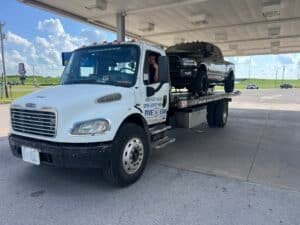
For drivers in Oklahoma City and the surrounding areas, Five Star Towing is that backup plan. We show up with professional-grade equipment and years of hard-won recovery experience for every single job. Don’t risk causing thousands of dollars of damage to your vehicle with improper techniques. Give Five Star Towing a call for fast, safe, and reliable recovery services.
Frequently Asked Questions
Take your foot off the gas. Immediately. This is the most important thing you can do to stop the situation from getting worse, as it prevents your vehicle from digging itself deeper into the ground.
When your wheels spin, they act like little excavators, flinging away the very material you need for traction. This lowers your chassis onto the ground, a state known as "high-centering," which dramatically increases the force needed to get you out.
Get out and take a look. Is the frame or the axles of your vehicle resting on the ground? If so, no amount of throttle is going to free it. You'll have to either dig it out or lift it up first.
A good starting point is to deflate your tires down to 20-25 psi. This will significantly improve your vehicle's ability to float over soft surfaces like sand and mud.
Lowering the pressure flattens and lengthens the part of the tire touching the ground (the contact patch). This spreads the vehicle's weight over a larger area, reducing ground pressure and helping you stay on top of the surface instead of slicing through it.
Always carry a portable air compressor with you. As soon as you get back to solid pavement, you need to reinflate your tires. Driving at highway speeds on under-inflated tires creates dangerous heat and can lead to total sidewall failure.
If you have a second vehicle with good traction nearby, a snatch strap is great for a quick extraction. If you're alone or need a more controlled, precise pull, a winch is the better tool.
A snatch strap is a kinetic rope, it stretches and then recoils, using that stored energy to "pluck" the stuck vehicle out. A winch, on the other hand, provides a slow, steady, and static pull. This controlled movement is much safer in tricky situations, like on the edge of a ravine or a steep hill.
Honestly, it's best to carry both. A snatch strap is faster for simple bogs, but a winch is an indispensable lifeline for solo travelers or for complex, technical recoveries where adding momentum could be dangerous.
As a rule of thumb, your recovery gear should be rated for at least two to three times the Gross Vehicle Mass (GVM) of your vehicle. This builds in a crucial safety margin to account for the added forces of suction and resistance.
As we discussed, deep mud can create a suction force equal to 100% of your vehicle's weight. When you add the resistance from an incline, the load on your gear can skyrocket. That's why high-capacity straps (e.g., 30,000 lbs) are recommended. They ensure you stay well within the gear's safe working load limit (WLL).
Never, ever use a "tow strap" with metal hooks on the ends for a recovery. Use a purpose-built "recovery strap" or "snatch strap" with closed, stitched loops. If a strap with metal hooks breaks, those hooks become lethal projectiles.
Absolutely. Self-recovery is entirely possible, but it requires having the right tools, like traction boards, a good shovel, or a winch.
Traction boards, like Maxtrax, essentially provide a portable ladder that your tires can climb to get out of a rut. A winch allows you to pull yourself free by anchoring to something solid, like a tree or a specialized ground anchor.
If you frequently travel alone, a winch and a set of traction boards should be considered mandatory equipment. Without another vehicle to pull you out, these tools are your only way to rescue yourself without having to walk for help.
Recovery boards are durable nylon tracks covered in raised lugs. You wedge them under your spinning tires to give them something to grip onto and regain traction.
They serve two purposes, they distribute your vehicle's weight over a larger area and provide a high-friction surface for the tire tread to bite into. They are essential for getting moving on slippery surfaces like sand, mud, and snow where your tires can't find any purchase.
After you've wedged them firmly under your drive wheels, accelerate slowly and gently. If you spin your tires wildly on them, you'll just melt the plastic lugs right off the board, destroying your expensive gear.
Spinning your tires does three bad things. It creates damaging heat, it ruins the terrain around you, and most importantly, it digs your vehicle down until its frame is resting on the ground (a "high-centered" state).
Once your vehicle is high-centered, you're not just fighting for traction anymore; you're also fighting the immense friction of the chassis being dragged through the dirt. On top of that, rapid spinning can overheat and damage your transmission and differentials.
Follow the two-second rule. If you apply the gas and don't make any forward progress within two seconds, stop. Get out and change the situation; dig, air down, or use traction aids instead of trying to force your way out.
A vehicle is "high-centered" when its weight is supported by its frame, skid plates, or differentials instead of its tires.
In this state, the tires are either hanging in the air or don't have enough weight on them to generate any friction. A simple pull often won't work because you're essentially trying to drag the vehicle's entire belly through the earth.
You have to lift the vehicle. Use a high-lift or bottle jack to raise the chassis, then fill the holes under the tires with rocks, logs, or your traction boards. This gets the weight back onto the wheels where it belongs.
For mud, nothing beats a dedicated "Mud-Terrain" (M/T) tire. Their superiority comes from the large, open voids between the tread blocks.
These wide voids allow the tire to "self-clean." As it spins, the mud is flung out, keeping the tread blocks clear and able to bite into the ground. All-Terrain or standard road tires will quickly pack with mud, effectively turning into useless "slicks" with zero traction.
If you know you'll be driving in muddy areas around OKC, investing in a good set of M/T tires is a smart move. Just be aware that they are typically louder on the highway and will wear out faster than standard road tires.
The first things you should inspect are your differential breathers, wheel wells, and brakes. Do it immediately.
When a hot differential is plunged into cold water or mud, it can create a vacuum that sucks contaminants in through the seals, which will quickly destroy your expensive gears. Mud packed inside your wheels will throw them severely out of balance.
As soon as you can, give the undercarriage a thorough wash. Dried mud traps moisture against the frame, which will accelerate rust and corrosion, a major problem in humid or salt-prone environments.
The basic professional formula is: Force = Vehicle Weight (W) + Rolling Resistance (ARR) + Gradient Resistance (AGR).
A simple pull on flat, dry sand might only require 30% of your vehicle's weight in force. But if you're stuck in deep, suctioning mud on a steep incline, that number can easily jump to 100% or more.
When in doubt, always overestimate the force required. If your best guess suggests you need a 5,000 lb pull, use a snatch block to double your winch's capacity or use a recovery strap rated for 15,000+ lbs to give yourself a wide safety margin.
It is far safer and much more effective for the driver of the stuck vehicle to provide "drive assist" by gently applying the throttle.
Pulling a vehicle in neutral means it's dead weight, forcing your recovery gear to do 100% of the work. Having the driver assist can reduce the load on your winch or strap by 30-50%, as proven time and again in real-world load tests.
Clear communication is essential here. The driver of the stuck car should maintain a steady, low throttle to help the pull without spinning the tires or overrunning the recovery strap, which can be very dangerous.
The two most dangerous and common mistakes are shock loading a strap (getting a running start) and using unrated gear for recovery points (like a tow ball).
Shock loading creates massive spikes in force that can snap straps or break metal parts. Using a tow ball as a recovery point is incredibly dangerous; they are not designed for the shear forces of a recovery and can snap off, turning the metal ball into a cannonball.
Never, ever recover off a tow ball. Always use properly rated recovery points that are bolted directly to the vehicle's chassis, and connect your gear using soft shackles or rated D-ring shackles.