

Passing a car broken down on the highway usually brings a quick flash of sympathy. You see the blinking hazard lights, give them a wide berth, and carry on. But for a professional tow operator, that same scene is a different world entirely. It is a rapid-fire calculation of weight, tricky angles, and crucial safety vectors.
The truck that arrives to help isn’t just a truck; it is a mobile warehouse packed with specialized steel, powerful hydraulics, and cutting-edge technology. Getting the job done right depends as much on the gear tucked away in the lockers as it does on the skilled driver behind the wheel.
Every single chain, winch, and safety vest has a specific, vital role to play in turning a dangerous, chaotic roadside situation into a controlled, successful recovery.
Key Notes
- High-visibility clothing and impact-resistant gloves protect operators from passing traffic and heavy machinery.
- Recovery vehicles are built for the job, ranging from light-duty flatbeds for family sedans to massive 75-ton rotators for overturned semi-trucks.
- Operators must know the Working Load Limits for every chain and strap to prevent dangerous failures.
- GPS, telematics, and digital dispatching systems help operators reach stranded drivers faster and more efficiently than ever.
Why High-Visibility PPE (Personal Protective Equipment) Comes First
While metal and hydraulics are what move the cars, it is the high-visibility gear that keeps the operator alive to run them. Working just inches away from traffic that is flying by at highway speeds is, statistically, one of the most dangerous jobs in the United States.
The AAA Foundation for Traffic Safety reports a truly grim statistic; on average, a tow provider is killed on the job every two weeks. That is about 60 operators a year who die from being struck by a vehicle. These “struck-by” incidents highlight just how critical the “Slow Down Move Over” law is, but operators can’t afford to rely only on other drivers’ compliance. They have to make themselves impossible to miss.
Understanding ANSI Standards and Vest Classes
Being visible isn’t a matter of personal preference; it is governed by strict, life-saving standards. The American National Standards Institute (ANSI) rates safety apparel to make sure workers can be clearly seen in all sorts of conditions. Tow operators working on active roadways are required to wear, at a minimum, ANSI/ISEA 107 Class 2 apparel. This rating guarantees that a person’s torso will be highly visible. However, the demanding conditions around Oklahoma City often call for an even higher level of protection.
Any work on federal-aid highways, during night operations, or in severe weather demands Class 3 apparel. The difference between Class 2 and Class 3 could be the difference between a driver seeing an indistinct blur and clearly recognizing a human being. A Class 2 vest provides solid coverage for your core. Class 3 garments add sleeves and pack in more retroreflective material across the torso and arms. This creates a distinct “human silhouette,” which helps passing drivers instantly identify a person and their movements, buying them precious, life-saving seconds to react.
Head-to-Toe Protection Beyond the Vest
Visibility is key for handling the risk from traffic, but the recovery work itself is full of heavy loads and sharp metal edges. That is why steel-toed, slip-resistant work boots are essential, providing a stable foundation on slick asphalt or muddy shoulders. An operator’s hands are especially vulnerable when setting up the rigging. That is why they rely on impact- and cut-resistant gloves to handle steel cables. A single frayed wire on a winch line can slice through unprotected skin in an instant.
From there, situational awareness fills out the rest of the kit. Safety glasses are a must to shield eyes from debris that can get kicked up during a winching operation. On more complex recovery scenes, like those involving rollovers or serious structural damage, a hard hat becomes mandatory. All this gear comes together to form a defensive shell, allowing the operator to block out the hazards and focus entirely on the technical challenge of the recovery.
Choosing the Right Rig
There is no single truck that can handle every call that comes in. A professional towing fleet is carefully categorized by its Gross Vehicle Weight Rating (GVWR), a number that dictates exactly what a truck’s chassis can safely handle. At Five Star Towing, we maintain a diverse lineup to make sure we always send the right tool for the job, whether it is a stalled sedan on I-35 or a delivery truck stuck in a ditch.
Understanding Truck Classes and Recovery Types
The industry generally divides trucks into three classes; light, medium, and heavy-duty. Light-duty trucks (Class 3-5) have a GVWR between 10,001 and 19,500 lbs. These are the workhorses that handle the bulk of daily calls for passenger cars, light pickups, and SUVs. Medium-duty trucks (Class 6-7), with a GVWR of 19,501 to 33,000 lbs, are called in for heavier loads like delivery vans, RVs, and box trucks.
At the very top of the food chain are the heavy-duty rigs (Class 8). With a GVWR of 33,001 lbs and up, these massive machines are dispatched to recover semi-trucks, buses, and heavy construction equipment. But within these classes, the way they lift also varies. The Wrecker, often called a boom truck, uses a winch and a boom arm to lift one end of a vehicle off the ground.
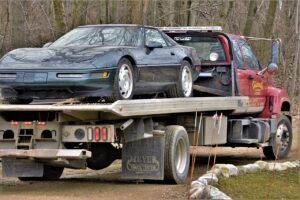
They are incredibly agile, which makes them perfect for navigating tight urban spaces in OKC. On the other hand, the Rollback (or flatbed) uses a hydraulic bed that slides down to ground level. This method is absolutely essential for all-wheel-drive (AWD) vehicles, as it prevents serious drivetrain damage by carrying the car entirely, rather than dragging it.
The Rotator and Extreme Recovery
While standard wreckers pull from the back, some situations demand serious vertical lifting power. This is where the Rotator comes in, it is the absolute apex of recovery engineering. A Rotator functions like a mobile crane, featuring a massive boom that is capable of a full 360-degree rotation. This unique ability lets the operator park in a safe, stable position while swinging the boom out over embankments or highway retaining walls to make a lift.
These incredible machines are deployed for only the most complex and dangerous scenarios. A Rotator can lift a vehicle straight out of a deep ditch or clear a multi-vehicle accident on a crowded highway without having to block all lanes of traffic. The lifting capacity on these beasts can exceed an astonishing 75 tons, and their winches are just as formidable, often boasting individual pulling capacities of over 50,000 lbs.
The Tools of Recovery
The truck itself provides the solid anchor point, but it is the rigging that connects all that power to the vehicle in distress. This critical system is made up of winches, chains, and straps. An operator has to correctly calculate the resistance of the mired vehicle and then choose gear with a suitable Working Load Limit (WLL). A misjudgment here can lead to snapped lines and a dangerously unpredictable recoil.
Winch Systems and Line Materials
The winch is the heart and soul of any recovery operation. Safety protocols demand that a winch must have a pulling capacity of at least 1.5 times the gross weight of the truck it is mounted on. Operators also have to be masters of the physics of the winch drum. A winch’s maximum pulling power is rated for the very first layer of rope on the drum. That power actually decreases by about 10% for each additional layer of rope that wraps around it.
The winch line material itself is constantly evolving. Traditional steel cable is incredibly durable and holds up well against abrasion on rough surfaces like concrete. However, it is also very heavy and stores a lethal amount of kinetic energy if it snaps. Because of this, many operators are now shifting to synthetic winch rope. It is up to 80% lighter and even floats in water.
Most importantly, it stores far less energy, meaning it will simply drop to the ground if it breaks instead of whipping back violently. The trade-off is its vulnerability; synthetic rope needs to be protected from sharp edges and long-term UV damage.
Chains, Straps, and Essential Hardware
Connecting the winch line to the car requires very specific hardware. Chains are graded by their strength. Grade 70 (G70) is the industry standard for securing vehicles for transport. A 3/8″ G70 chain has a WLL of 6,600 lbs. For any overhead lifting or more extreme recoveries, operators will upgrade to Grade 80 or even Grade 100. A 3/8″ G100 chain, for example, boosts the WLL up to 8,800 lbs.
But static chains aren’t always the right tool. For recoveries in deep mud or snow, operators often turn to synthetic snatch straps. These specialized straps are designed to stretch, using kinetic energy to “snatch” a stuck vehicle free without the jarring shock load you’d get from a chain. This whole system is held together by heavy-duty D-ring shackles and often includes a snatch block.
A snatch block is essentially a heavy-duty pulley that lets the operator change the angle of the pull or even double the winch’s pulling power, giving them a massive mechanical advantage.
The Roadside Assistance Toolkit
A tow is often the last resort. A huge number of service calls are actually for roadside assistance. According to AAA, the most common reasons people call for help are dead batteries, flat tires, and getting locked out of their car. A professional’s truck carries a whole secondary arsenal of tools designed to get drivers back on the road without needing a tow at all.
Entry and Power Tools
Modern vehicle security systems are more complex than ever. Opening a locked car requires a delicate touch to avoid damaging sensitive door seals or side airbags. Operators use professional lockout kits that feature long-reach tools and inflatable air wedges. These wedges are carefully inserted to gently pry the door frame open just enough to slide a tool inside and manipulate the lock mechanism.
The way we deliver power has evolved, too. The days of relying on long, cumbersome jumper cables are fading. Trucks now carry professional-grade lithium-ion jump boxes, like the NOCO Boost. These compact units can deliver over 4,000 peak amps of power. They’re much safer for modern vehicle electronics than a direct cable connection and pack enough punch to start large diesel engines, even on a cold Oklahoma winter morning.
Tire Service and Site Safety
Tire failures are a constant on our roads. Every well-equipped truck carries a portable air compressor and a high-quality floor jack. For punctures that can be safely repaired on the spot, a tire plug kit allows for a reliable temporary fix to get the driver to a proper tire shop. Operators also carry a 4-way lug wrench to be ready for the various lug nut sizes on different vehicles.
Environmental safety is just as important. Accidents often lead to fluid leaks. That is why trucks are equipped with a spill containment kit containing absorbent pads and granules. Operators are responsible for cleaning up any oil, coolant, or fuel spills to prevent environmental contamination and to remove slippery hazards for other motorists.
Technology Driving Modern Towing
The old clipboard and crackly radio are relics of a bygone era. Modern towing operations run on sophisticated software that connects the dispatcher, the driver, and the customer in real-time. This digital integration makes the whole process safer, faster, and more accountable.
Software and Telematics
Dispatching is now managed through specialized platforms like Towbook, Omadi, or Swoop. These systems can assign a job to the nearest available driver in an instant. In-cab telematics provide live GPS tracking, which lets dispatchers monitor a truck’s speed and location. This data helps in optimizing routes, which can reduce fuel costs by up to 20% and ensures we can give stranded customers an accurate arrival time.
Streamlining Operations
That efficiency continues once the truck is on the scene. Mobile payment systems allow operators to securely process credit cards right there at the roadside, cutting down on administrative headaches. All the documentation is now digital, too. Operators perform Digital Vehicle Inspection Reports (DVIRs) using their smartphones or tablets. They take detailed photos of the vehicle’s condition before the tow, creating a timestamped record. This simple step protects the towing company from fraudulent damage claims and gives the vehicle owner complete peace of mind.
The gear packed inside a Five Star Towing truck represents a deep commitment to professional, high-quality service. It is a carefully curated collection of tools chosen for their safety, power, and precision.
From the high-visibility vest that protects the operator to the software that tracks the entire fleet, every single item plays a role in making sure that help arrives fast and the job gets done right. When you find yourself stranded on the side of the road in Oklahoma City, you need more than just a truck; you need the expertise and the right equipment to get you home safely.
Frequently Asked Questions
A wrecker and a rollback are designed for different jobs depending on the condition and type of the vehicle.
Wreckers, also called boom trucks, use a boom and winch to lift one end of a vehicle so it can roll on its remaining tires. Their maneuverability makes them ideal for removing cars from tight city parking spots or pulling vehicles from ditches.
Rollbacks, or flatbeds, have a bed that hydraulically tilts and slides down to the ground, allowing the vehicle to be winched entirely onto it. This method is the safest way to transport all-wheel-drive vehicles or cars with heavy damage because it protects the drivetrain and keeps the vehicle completely off the road.
Operators choose the right truck for each situation. Rollbacks are generally preferred for long-distance tows or high-end vehicles, while wreckers are often faster for clearing illegally parked cars or performing recoveries in confined spaces.
High-visibility personal protective equipment is the most important defense for operators against struck-by incidents, which are a leading cause of death in the towing industry. Working on the roadside puts operators just inches away from fast-moving traffic, making visibility a matter of life and death.
ANSI Class 2 and Class 3 vests use retroreflective materials to create a clear human silhouette. This helps drivers instantly recognize a person rather than just the flashing lights of a truck, giving them more time to react and avoid a collision.
The danger is very real, with the AAA Foundation for Traffic Safety reporting that a tow provider is killed roughly every two weeks. Wearing high-visibility gear is not only common sense but also a legal requirement to comply with federal and state safety regulations when working on the roadside.
A winch's capacity rating indicates the maximum weight it can safely pull without risking a catastrophic failure. It is important to choose a winch that provides a sufficient safety margin to account for the unpredictable conditions of a recovery, such as mud, steep inclines, or vehicle damage that increases resistance.
Industry experts recommend that a winch should have a capacity of at least one and a half times the gross weight of the truck it is mounted on. This buffer ensures that the winch can handle the additional strain and reduces the risk of overloading during challenging recovery operations.
The pulling power of a winch is strongest on the first layer of rope wrapped around the drum and decreases by about ten percent with each additional layer because the leverage changes. Operators must understand these physics to avoid exceeding the winch's limits, and using a snatch block can effectively double the line's pulling power, allowing a smaller winch to safely handle a much heavier load.
The move toward synthetic rope in towing focuses on improving safety and reducing weight, even though steel has long been valued for its durability. Synthetic rope handles stored energy much more safely than steel.
If a steel cable snaps under heavy load, it can whip back with lethal force, whereas synthetic rope stores far less kinetic energy and will usually just fall to the ground, greatly lowering the risk of serious injury.
Synthetic rope is also significantly lighter than steel, sometimes up to eighty percent less in weight. This reduction eases the load on the front of the truck and makes it much easier for operators to handle the line over steep inclines or through rough terrain.
Lighter equipment means faster, safer, and less exhausting operations for recovery teams.
Despite these advantages, synthetic rope requires careful maintenance. It is more susceptible to cuts, abrasion, and damage from UV exposure, so it needs protective sleeves and frequent inspections.
Steel rope, in contrast, is more resistant to scraping against concrete or jagged metal, which makes it more forgiving in harsh conditions, but it comes with higher safety risks if it fails.
A Rotator is a highly specialized heavy-duty truck built to handle the most challenging and complex recovery jobs. Unlike a standard tow truck that pulls only from the back, a Rotator features a boom that can rotate a full 360 degrees.
This design allows the truck to park parallel to an accident scene and swing its boom over to lift a vehicle, functioning in many ways like a mobile crane.
These trucks are essential for extreme recovery situations such as rolled-over semi-trucks, vehicles that have fallen down steep embankments, or heavy machinery.
With lifting capacities that can exceed seventy-five tons, rotators are capable of raising massive loads straight up, making them indispensable for high-risk and heavy-duty recoveries.
Rotators also contribute to traffic management by allowing crews to work from the shoulder or a single closed lane while reaching the accident site. This capability helps minimize traffic disruption, enabling crews to clear highways more quickly and restore traffic flow efficiently.
Their combination of power, precision, and flexibility makes them a critical asset in roadside recovery operations.
Tow operators are often the first responders on an accident scene and play a key role in addressing environmental hazards.
Collisions frequently cause radiators, oil pans, or fuel tanks to rupture, and a spill containment kit provides absorbent pads and granular material that can quickly soak up these fluids before they seep into the ground or run into storm drains. Prompt cleanup helps reduce the risk of secondary accidents caused by slick surfaces that endanger other drivers and emergency personnel.
Using these kits also ensures compliance with federal and local environmental laws that require proper cleanup of hazardous materials. Carrying spill containment equipment allows a towing company to maintain road safety while adhering to regulations for hazardous waste.
A snatch block is a heavy-duty pulley encased in metal and is an essential tool for complex recoveries.
When an operator routes the winch line out to an anchor point and back to the tow truck in a double-line pull, the snatch block effectively doubles the winch’s pulling capacity. This allows a truck to recover a vehicle that is much heavier than the winch’s standard rating.
In many recoveries, the tow truck cannot achieve a straight-line pull on the vehicle. The snatch block allows the operator to change the direction of the pull, enabling them to winch around corners or obstacles while keeping the tow truck stable and safe.
It also reduces strain and heat buildup in the winch motor and stress on the line, which helps preserve the equipment and extend its lifespan.
Professional lockout services focus on gaining access to a vehicle without causing any damage to the paint, weather stripping, or internal mechanisms.
The most common technique uses an inflatable air wedge, which is slipped between the door and the frame and manually pumped with air. This gently creates a small gap just large enough to fit a tool through, avoiding any bending of the door frame.
Once the gap is established, a long-reach tool, which is a thin rubber-coated rod, is carefully inserted to flip the lock switch, pull the interior handle, or retrieve keys left inside.
This modern method prevents damage and is far safer than older tools like Slim Jims, which could disconnect window linkage or harm side-impact airbag sensors, making today’s lockout kits fully non-invasive.
Gross Vehicle Weight Rating, or GVWR, is the maximum operating weight for a vehicle as determined by the manufacturer. This weight includes the chassis, body, engine, fuel, all accessories, the driver, and any cargo being carried.
GVWR is what determines a tow truck’s classification as light, medium, or heavy-duty. For instance, a Class 3 light-duty truck has a GVWR between 10,001 and 14,000 pounds, while a Class 8 heavy-duty rig starts at 33,001 pounds.
Staying within the GVWR is critical for the truck’s braking and steering performance, as overloading can severely reduce stopping power and lead to mechanical failure. Exceeding the rated capacity is also illegal and creates significant liability, making it essential to match the right truck to the load for safe towing operations.
Chain grades indicate the tensile strength of the metal, and Grade 70 is specifically intended for securing cargo during transport. Grade 70 chain, often identifiable by its gold-chromated finish that resists corrosion, is made from heat-treated carbon steel and meets the Department of Transportation standard for tying down loads on public highways.
A standard 3/8" Grade 70 chain has a Working Load Limit of 6,600 pounds. This provides an excellent strength-to-weight ratio, making it easy for operators to handle on a daily basis while still offering more than enough security for passenger vehicles.
It is important to understand that Grade 70 chains are different from Grade 80 or Grade 100 chains, which are approved for overhead lifting. While Grades 80 and 100 are stronger, Grade 70 is the designated standard for securing vehicles to flatbeds and ensuring they do not shift during transit.
Dispatch software acts as the digital brain of a modern towing company, replacing outdated paper logs and unreliable radio communication. Operators can enter call details directly into platforms like Towbook or Omadi, which instantly send the information to the driver’s phone or tablet. This streamlined process reduces mistakes and significantly speeds up response times.
These systems integrate GPS and telematics to show dispatchers the exact location of every truck in real time. Using this data, they can assign calls to the closest available unit, which minimizes wait times for customers and reduces fuel consumption for the fleet.
The software also maintains a complete digital record of every job, from dispatch to completion, including photos and payment information. This thorough documentation is essential for accurate billing, insurance claims, and internal audits, providing both accountability and transparency for the towing company.
In the towing industry, a DVIR is a digital log used to record the exact condition of a vehicle both before and after it is moved. Operators use a tablet or phone to take pictures of any existing damage such as dents, scratches, or flat tires. These images are timestamped and geo-tagged, creating a precise record of the car’s condition.
This process provides important liability protection for towing companies. By documenting the vehicle’s condition, it prevents false claims where a customer might attempt to hold the tow operator responsible for pre-existing damage. The transparency it creates ensures clear communication between the service provider and the vehicle owner.
A DVIR also serves as a safety verification tool. It prompts the operator to confirm that the vehicle is properly secured according to protocol before beginning transport. This step not only protects the vehicle but also enhances overall road safety, reducing the risk of accidents or incidents during the tow.