

Picture this, you’re stranded on the shoulder of I-40, smoke is billowing from under the hood, and the last thing on your mind is paperwork. Your stress level is through the roof as traffic screams past at seventy miles per hour. But when the tow truck finally pulls up, one of the first things the operator will ask for is your ID and proof of insurance.
This isn’t some bureaucratic red tape meant to slow down your rescue. It’s a critical safety step that determines how your vehicle gets handled, who foots the bill, and whether your car can legally be moved at all.
Verifying your insurance coverage is what protects you from getting hit with shocking out-of-pocket costs and shields the towing provider from potentially massive liability.
The modern towing industry in Oklahoma City operates on a smart mix of real-time digital checks and old-fashioned physical inspections to keep the roads clear. Taking a few minutes to understand this process can be the difference between a simple breakdown and a full-blown financial disaster.
Key Points
- Verifying your insurance provides financial protection because it prevents you from being charged immediate cash call rates, which are always much higher than the prices negotiated by your insurance company.
- Having valid insurance ensures smoother and faster handling if any accidental damage occurs during the tow, protecting both you and the towing company from unnecessary complications.
- Most insurance verifications today happen instantly through digital systems before the tow truck even arrives, thanks to smart integrations with motor clubs.
- You cannot retrieve your vehicle from an impound lot without showing proof of current insurance. This can lead to storage fees that pile up frighteningly fast.
The Immediate Consequences of Unverified Insurance
It is easy to assume that a tow truck will just move your vehicle no matter what, and you can figure out the billing later. That’s a common, but risky, assumption. The moment a tow operator can’t verify your coverage, the entire situation shifts. It’s no longer a claim handled by a third party; it’s now a direct retail transaction between you and the towing company. The first and most immediate impact is on your wallet.
Paying Out-of-Pocket
When there is no verifiable insurance, the service gets labeled a “cash call.” The safety net of your policy vanishes, and you are now personally and directly responsible for the entire bill.
- You will be asked to pay with cash or a credit card immediately, before your vehicle is even hooked up.
- Insurance companies are able to negotiate lower rates because of the volume of business they provide. As a cash customer, you are responsible for the full retail price. A standard 10-mile tow that would have a $0 deductible under your policy could easily cost $150 or more on the spot.
- Unlike other services where you might receive an invoice in the mail, roadside assistance is an on-demand industry and payment is expected immediately, before the service is completed.
The Possibility of Service Refusal
Outside of an emergency, a towing company has every right to refuse service. A vehicle isn’t just a car; it is a significant liability. If a customer has no proof of insurance and cannot show they can pay for the tow, the operator is looking at a guaranteed loss. Moving a vehicle without any assurance of payment or coverage is an unacceptable risk for any business. A reputable provider like Five Star Towing has to balance the genuine desire to help people with the practical need to run a sustainable business. If the risk of non-payment is too high, the truck may have no choice but to leave the scene.
Police-Initiated Tows and the Impound Lot Nightmare
The situation gets exponentially more serious if the police get involved. After an accident or if your vehicle is considered abandoned, an officer will authorize a tow to a designated impound lot. This is where not having insurance goes from being a headache to a full-blown crisis. To get your vehicle back, you must present proof of current, valid financial responsibility; your insurance. This rule is absolute and has no exceptions.
The Insurance Information Institute reveals a startling statistic. About 12.6% of drivers in the U.S., or roughly one out of every eight people on the road, are uninsured. For these drivers, getting impounded is a financial catastrophe. The initial tow to an impound lot can cost anywhere from $125 to $350. From there, storage fees start racking up every single day, typically between $40 and $100. If your car sits for 30 days while you’re scrambling to get insurance, those fees can balloon to over $3,000, which is often more than the car is even worth.

Why Insurance Verification is a Critical Step for Every Tow
Protecting Against Six-Figure Financial Risks
Towing a vehicle is a heavy-duty operation. It involves powerful machinery, complex situations, and the ever-present danger of unpredictable traffic. While the risk of damage is low with skilled operators, it’s never zero. Insurance verification is the shield that protects both you and the towing company. If a towed vehicle is somehow damaged, the tow company’s garage keepers insurance or commercial liability policy is there to cover the repairs.
But for that to work smoothly, the system relies on something called subrogation, which is basically just a legal process where the insurance companies sort out who pays for what among themselves.
For subrogation to work, there needs to be a clear line of responsibility. If a tow operator accidentally scratches your bumper, their insurer might pay for the repair upfront, but they will then talk to your insurance company to figure out the final liability. When you have active, valid coverage, this is a clean and efficient process.
Without it, the tow company is staring into a financial black hole. When you consider that the average cost of a commercial auto liability claim is around $70,000, you can see why operators can’t afford to just guess. Verifying your insurance confirms that if the worst-case scenario happens, the proper systems are in place to resolve it.
Ensuring Payment for Services Rendered
The vast majority of roadside assistance calls in Oklahoma City are routed through motor clubs like AAA or Agero. In these cases, verifying your insurance is what triggers the payment to the tow company. The tow company isn’t paid by you on the side of the road; they’re paid by the motor club, which then gets its money from your insurance provider.
If your policy has lapsed, that whole payment chain breaks down. A call from a motor club is supposed to come with a pre-approved guarantee of payment. If the policy isn’t active, the motor club won’t pay the tow company. Towing and storage fees after an accident can easily top $500.
If an operator does all that work based on a bad policy, they get stuck with a debt they can’t collect. Checking the policy status before the hook ever drops makes sure the driver isn’t working for free.
Complying with State and Local Towing Regulations
Towing is a business with a lot of rules. Laws in Oklahoma and across the country dictate exactly how and when a vehicle can be moved, especially for non-consensual tows from private property or accident scenes. These laws often state that a vehicle cannot be released from storage until the owner shows proof of financial responsibility.
You can see how strict these rules are by looking at the California Vehicle Code, which makes it crystal clear that impounded vehicles can’t be released without current registration and valid insurance.
While the specific laws change from place to place, the principle is the same, the company holding the vehicle acts as a gatekeeper. Releasing an uninsured car back onto the road could get the tow company in serious trouble, including legal action and hefty fines.
The On-the-Spot Verification Process
Motor Club & Digital Dispatch
In a perfect world, the verification happens so smoothly you don’t even know it’s happening. When you call your insurance provider or motor club for help, they confirm your policy is active right then and there. Once that’s done, they dispatch the request to a local provider like Five Star Towing through a business-to-business (B2B) digital platform.
Companies like Agero, Swoop, and Urgently are the powerhouses in this space. When the job alert pops up on the tow driver’s tablet, it’s already marked as a “verified” dispatch. The driver knows the payment is secure and the insurance is good to go. This seamless flow of information takes all the friction out of the roadside interaction, letting the operator focus completely on getting you and your vehicle recovered safely.
Visual Confirmation
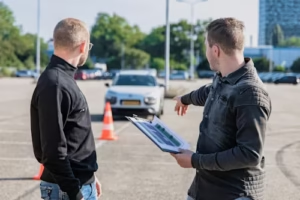
If a job doesn’t come through a pre-verified network, the driver has to do a manual check on the spot. Operators are trained to be meticulous when they inspect insurance documents. They’re looking for the insurance company’s name, the policy number, and, most importantly, the effective start and end dates.
One of the most crucial steps is matching the Vehicle Identification Number (VIN). The driver will compare the VIN on your insurance card to the VIN plate on your vehicle’s dashboard or inside the driver’s side door.
This is a simple but effective way to prevent fraud, like someone trying to use an active insurance card from one car to cover another, uninsured vehicle. With J.D. Power reporting that 79% of auto insurance customers want digital solutions, drivers are more frequently showing digital ID cards on their phones. These are accepted just like paper cards, as long as all the details match the physical vehicle.
Real-Time API Verification
The most advanced towing operations use software that closes the gap between looking at a card and getting a digital dispatch. Modern systems can make direct Application Programming Interface (API) calls to the insurance carriers’ databases. Think of it like the driver’s software sending a secure, instant message to your insurer asking, “Is this policy active?”
By typing a VIN or policy number into their software, the driver can get a status update in seconds. This technology gets rid of the guesswork involved in looking at a PDF on a phone, which could have been altered.
An API verification gives a simple “verified” or “not found” answer, usually in less than five seconds. It’s a source of truth that’s hard to argue with, protecting the operator from taking a job that their system will later reject for payment.
Manual Phone Verification
Sometimes technology fails, or a driver might have insurance from a smaller, local company that isn’t connected to the big digital networks. In these situations, it’s time for the “old-school” method. The tow dispatcher, or sometimes the driver right there on the scene, will call the insurance company’s agent or customer service line.
They’ll provide your policy information to a live representative to verbally confirm that you have coverage for towing and roadside assistance. While this method definitely works, it’s slow. A manual phone call can easily take 10 minutes or more, depending on hold times which feel like an eternity when you’re stuck on the shoulder of a busy highway. It’s really only used as a last resort when the faster, digital options aren’t available.
The Technology Powering Instant Insurance Checks
Towing Management Software (TMS)
The incredible efficiency of today’s towing operations is all thanks to something called Towing Management Software (TMS). Platforms like Towbook, Beacon Software, and Omadi are the central nervous system for companies like Five Star Towing. This software does way more than just map out routes; it is like an air traffic control tower for all the data related to service calls and claims.
These TMS platforms are integrated with the motor clubs, so they receive jobs that have already been cleared and verified. The assignment automatically shows up in the driver’s queue as a legitimate, billable job.
This level of automation ensures that every dispatch is solid. Industry experts estimate that adopting TMS has boosted operational efficiency for towing companies by 25-40%, mostly by getting rid of the time-consuming administrative checks that used to require phone calls.
Digital Roadside Assistance Platforms
The bridge connecting your local tow truck to a massive national insurance carrier is a layer of digital infrastructure made up of roadside assistance networks. Platforms like Agero, Urgently, and Honk act as a digital marketplace for these services. They handle millions of service requests every year. Agero alone manages over 12 million events and routes them to the closest qualified towing provider.
Pre-verified insurance data is the currency that makes these platforms work. They filter every request, making sure that by the time a job reaches a local provider in OKC, all the financial questions have already been answered. This creates a much smoother and less stressful experience for you, the customer, who doesn’t have to argue over prices or prove you’re covered while stranded on the side of the road.
Mobile Apps for Drivers
The final, critical link in this high-tech chain is the smartphone or tablet inside the cab of the tow truck. Drivers use specialized mobile apps that are connected to their TMS to see all the details of a job. These apps have become powerful tools for documentation and verification.
Beyond just showing a map, these apps often include integrated VIN scanners. A driver can scan the barcode on your vehicle’s doorjamb, and it will instantly populate the system with the car’s year, make, and model. This confirms that the insurance policy matches the exact vehicle being towed. On top of that, these apps require drivers to take photos documenting the vehicle’s condition before it’s hooked up. This digital paper trail protects the towing company from false damage claims and provides undeniable proof of the vehicle’s state at the time of service.
Verifying insurance isn’t just a formality; it’s a vital part of the towing ecosystem that ensures safety, legality, and financial security for everyone involved. Whether it happens instantly through a digital API call or with a careful look at your digital ID card, the goal is always the same, to get you and your vehicle home safely, without any frustrating administrative surprises. For drivers in Oklahoma City who need reliable, professional, and fully compliant service, Five Star Towing has the expertise to handle your roadside needs with precision and care. When you see our truck, you can rest easy knowing you’re in capable hands.
Frequently Asked Questions
It can feel a little strange when a tow operator asks for your insurance card, but it is a normal and necessary part of the process. You almost always need to show proof of insurance to the tow truck driver, especially if the service is being billed through your insurance company or a motor club like AAA. The driver must verify that the vehicle being towed is the same one covered by the policy that authorized the service.
The Towing and Recovery Association of America considers it best practice to confirm a vehicle’s identity using the VIN and insurance documents. This step helps prevent fraud and ensures liability coverage is connected to the correct vehicle.
If you cannot or will not provide documentation, the tow may be treated as a cash call, meaning you must pay the full non discounted rate immediately. In some cases, if the liability risk is too high, the operator may refuse the service altogether.
Yes, a private towing company can legally refuse to tow your vehicle if you cannot show proof of insurance, particularly if you also cannot pay the full cash rate upfront. In a private transaction, the company is not required to take on the risk of moving an uninsured vehicle. Towing carries significant financial risk, with the average commercial auto liability claim costing around $70,000.
If an accident occurs during a tow and the customer has no insurance, it creates serious legal and financial exposure for the towing company. If you know you are uninsured, be prepared to pay a higher cash rate and possibly sign a liability waiver. Otherwise, you may be left roadside until you find a provider willing to accept the risk.
Finding out that your insurance has expired when you need a tow can quickly turn a routine service call into a costly situation. If your policy is no longer active, your insurance company will deny the roadside assistance request and will not dispatch a tow as a covered service. You will then need to contact a tow company yourself and pay for the service out of pocket.
According to the Insurance Information Institute, about 12.6 percent of U.S. drivers are uninsured, and for them roadside assistance is always a retail service that costs far more than a covered tow. If law enforcement becomes involved, an expired policy can lead to your vehicle being impounded. In that case, daily storage fees often ranging from $40 to over $100 can accumulate until you provide proof of valid insurance.
AAA and other motor clubs use digital systems that make membership verification almost invisible to the customer. As soon as you request service through the app or by phone, AAA verifies your membership status and coverage level, such as Classic, Plus, or Premier, before dispatching a tow.
Digital dispatch platforms allow this verification to happen in real time, so when the tow driver receives the job, it is already marked as approved and billable to the motor club. For you, the process is simple and usually only requires showing a physical or digital membership card along with a photo ID. All financial authorization is handled behind the scenes.
Tow companies do not call insurance companies as often as they used to, but it still happens in certain situations. If digital verification systems fail or if you only have a paper insurance card from a smaller carrier, the dispatcher or driver may call your insurance provider to confirm that your policy is active and includes towing coverage.
While automated verification is much faster, manual calls remain a necessary backup. If this happens, expect a short delay of about 10 to 15 minutes. The easiest way to avoid delays is to keep a digital insurance card on your phone that clearly shows your current coverage dates.
Garage keepers insurance is a special type of coverage that protects the tow company and works together with your own auto policy. It is designed to cover a customer’s vehicle while it is in the care, custody, and control of the tow company. This coverage protects your car from damage while it is being hooked up, transported, or stored at the tow company’s facility.
Having a commercial liability policy like this is a standard requirement for all professional tow operators. It specifically covers the customer’s property, which is different from the insurance that protects the tow truck itself.
Tow companies still check your insurance to ensure a smooth process for subrogation, which allows insurers to communicate and settle claims efficiently. If a minor incident occurs, having your own valid insurance makes it much easier for the tow company’s garage keepers policy to cover damages quickly without complicated legal disputes.